Control of Electronic Properties of MXenes

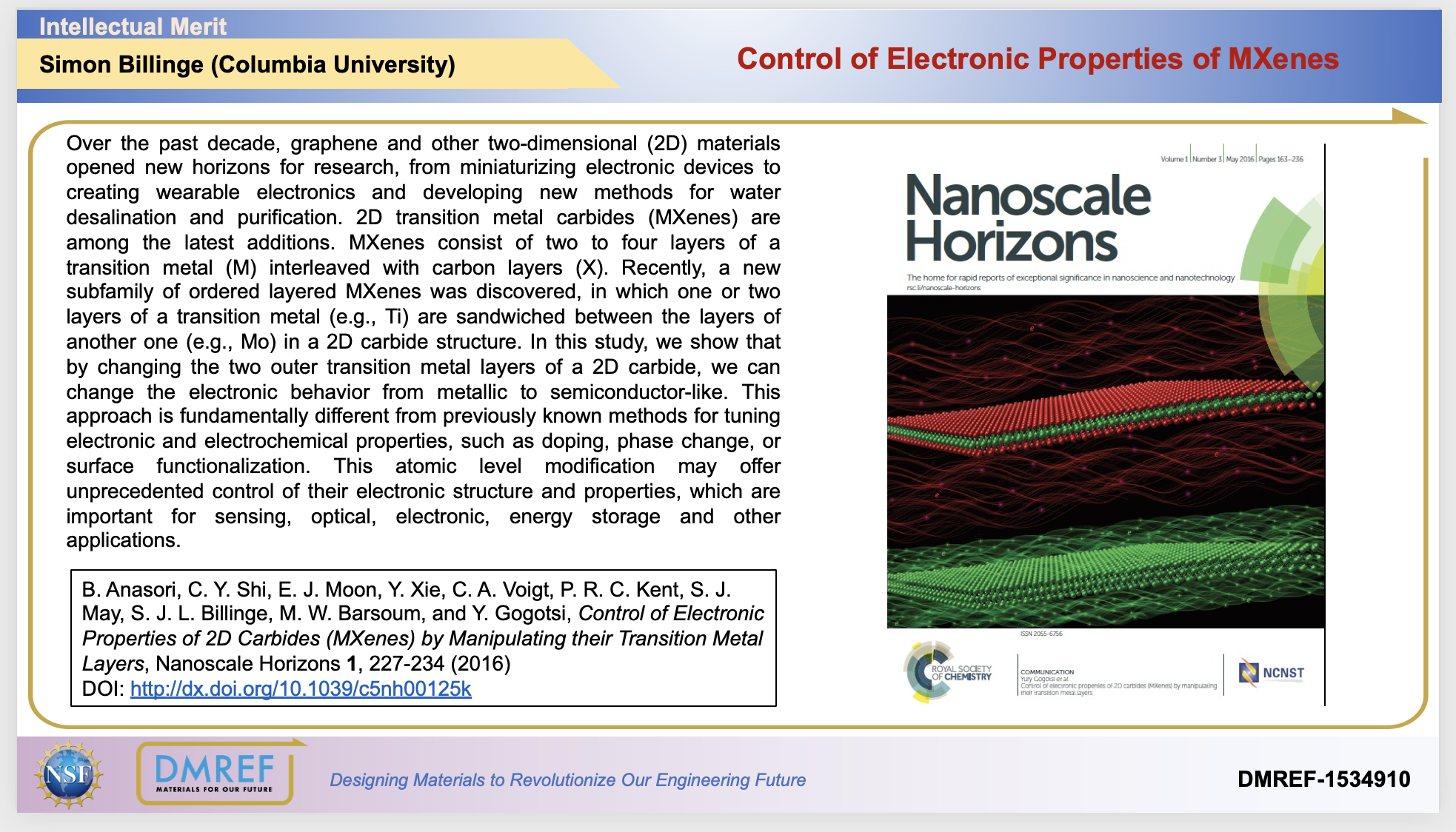
Over the past decade, graphene and other two-dimensional (2D) materials opened new horizons for research, from miniaturizing electronic devices to creating wearable electronics and developing new methods for water desalination and purification. 2D transition metal carbides (MXenes) are among the latest additions. MXenes consist of two to four layers of a transition metal (M) interleaved with carbon layers (X). Recently, a new subfamily of ordered layered MXenes was discovered, in which one or two layers of a transition metal (e.g., Ti) are sandwiched between the layers of another one (e.g., Mo) in a 2D carbide structure. In this study, we show that by changing the two outer transition metal layers of a 2D carbide, we can change the electronic behavior from metallic to semiconductor-like. This approach is fundamentally different from previously known methods for tuning electronic and electrochemical properties, such as doping, phase change, or surface functionalization. This atomic level modification may offer unprecedented control of their electronic structure and properties, which are important for sensing, optical, electronic, energy storage and other applications.