
Controlling Emission in Optical Materials
Aug 21, 2018
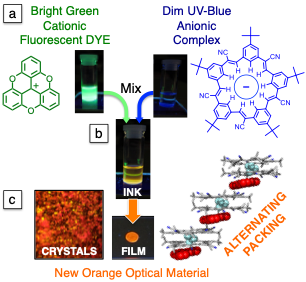
(a) Mixing green dye with blue complex (b and c) makes a new colored fluorescent ink for (c) crystals and thin films. The new color arises by the alternating packing of the two components

The optical properties of materials composed of organic dyes are defined by how the molecular dyes pack together in the crystal. If we can understand how the packing gives rise to the optical properties, then we can control the packing to generate materials of any color and brightness. However, the correlation between that packing and the materials optical properties are difficult to make.

We did this here by exploiting the typical way that opposite charges like to pack (+ – + –) through the crystal. In the molecular system of our study, we found a totally new fluorescent color emerge (orange) when mixing the cationic dye of one color (green) with anionic molecule showing only a dim color (UV-blue).

This discovery and the understanding gained is the first step in informing a model of the correlation between packing and optical properties for optimization in subsequent studies.

Publication

Authors

Amar H. Flood (PI), Steven L. Tait, Krishnan Raghavachari, Peter J. Ortoleva

Additional Materials

U.S. National Science Foundation and NSF DMREF, Materials for Our Future

This material is based upon work supported by the U.S. National Science Foundation Award No. 2015237. Any opinions, findings, and conclusions or recommendations expressed in this material are those of the author(s) and do not necessarily reflect the views of the U.S. National Science Foundation. This site is maintained collaboratively by principal investigators with NSF DMREF awards, independent of the NSF.