
Design of Nanoalloys in 3D Atomic Resolution
Aug 6, 2024
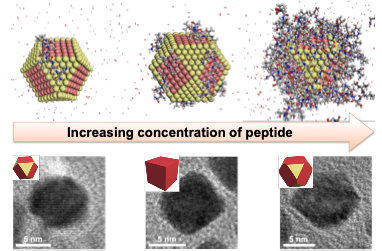
Peptide coverage of nanostructure-bounding facets determines growth directions of nanocrystals, shape, and reactivity in catalysis. Concentration-dependent changes were tracked by molecular dynamics simulation and HRTEM.

The mechanism of selective peptide recognition of Pt nanocrystals and peptide-directed growth into specific shapes has been explained using large-scale molecular dynamics simulation and experiment. The adsorption strength of the peptides depends on the spatial location on the surface and on the peptide concentration in addition to the actual peptide sequence (Figure). Quantitative correlations between preferences in facet coverage and binding energies with nanocrystal shape, size, and yield have been elucidated that can be helpful for the rational design of more complex structures.

PtNi alloy nanoparticles have also been synthesized and characterized in atomic resolution to understand atomic ordering, improve interatomic potentials, and rationalize catalytic performance.
Authors

Hendrik Heinz (University of Colorado Boulder) Yu Huang (UCLA)

Additional Materials

U.S. National Science Foundation and NSF DMREF, Materials for Our Future

This material is based upon work supported by the U.S. National Science Foundation Award No. 2015237. Any opinions, findings, and conclusions or recommendations expressed in this material are those of the author(s) and do not necessarily reflect the views of the U.S. National Science Foundation. This site is maintained collaboratively by principal investigators with NSF DMREF awards, independent of the NSF.