
A Neural Network Approach for Catalysis
Oct 7, 2024
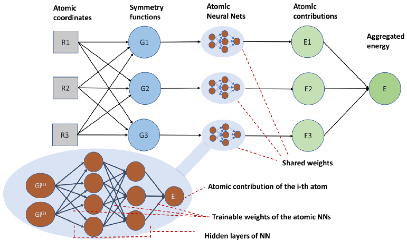
Network for the atomic contribution method. First, symmetry functions are calculated from the atomic coordinates of all the atoms in the molecule. Here, Gi denotes the vector containing the symmetry function values for the ith atom. For each atom, its corresponding G vector is fed to a neural network (NN). Each atomic NN learns the energy contribution of the corresponding atom to the total energy of the species. All the atomic contributions are summed to get the predicted energy.

Computational catalyst discovery involves the development of microkinetic reactor models based on estimated parameters determined from density functional theory (DFT). For complex surface chemistries, the number of reaction intermediates can be very large, and the cost of calculating the adsorption energies by DFT for all surface intermediates, even for one active site model, can become prohibitive. Here, a detailed investigation has been performed on a predictive model for both interpolation and extrapolation of adsorption energies of hydrocarbon species on a Pt(111) catalyst surface. Appropriate descriptors and machine learning models have been identified that can predict a significant part of these adsorption energies given data on the rest of them. Thus, a neural network predictive model has been developed that combines an established additive atomic contribution-based model with the concepts of a convolutional neural network that, when extrapolating, achieves a statistically significant improvement over the previous models.
Authors

G. A. Terejanu (University of North Carolina) and A. Heyden (University of South Carolina)

Additional Materials

U.S. National Science Foundation and NSF DMREF, Materials for Our Future

This material is based upon work supported by the U.S. National Science Foundation Award No. 2015237. Any opinions, findings, and conclusions or recommendations expressed in this material are those of the author(s) and do not necessarily reflect the views of the U.S. National Science Foundation. This site is maintained collaboratively by principal investigators with NSF DMREF awards, independent of the NSF.