Unveiling the Role of Termination Groups in Stabilizing Mxenes in Contact with Water
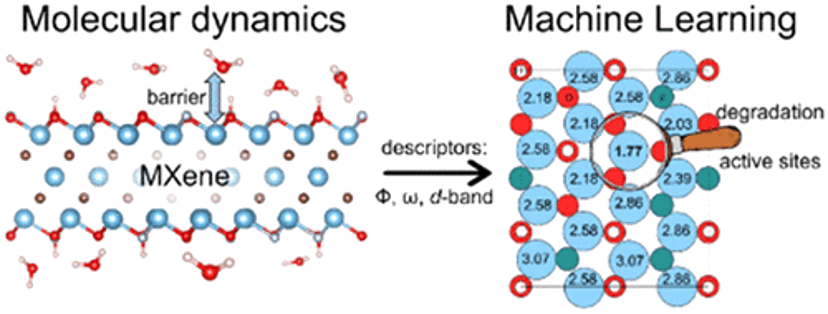
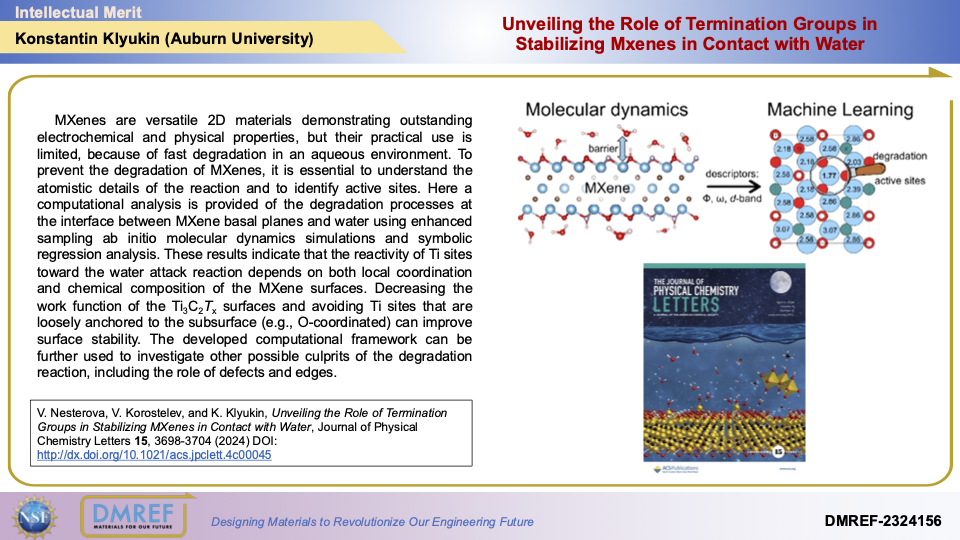
MXenes are versatile 2D materials demonstrating outstanding electrochemical and physical properties, but their practical use is limited, because of fast degradation in an aqueous environment. To prevent the degradation of MXenes, it is essential to understand the atomistic details of the reaction and to identify active sites.
Here a computational analysis is provided of the degradation processes at the interface between MXene basal planes and water using enhanced sampling ab initio molecular dynamics simulations and symbolic regression analysis. These results indicate that the reactivity of Ti sites toward the water attack reaction depends on both local coordination and chemical composition of the MXenesurfaces.
Decreasing the work function of the Ti3C2Tx surfaces and avoiding Ti sites that are loosely anchored to the subsurface (e.g., O-coordinated) can improve surface stability. The developed computational framework can be further used to investigate other possible culprits of the degradation reaction, including the role of defects and edges.