Room-temperature Superfluorescence in Hybrid Perovskites
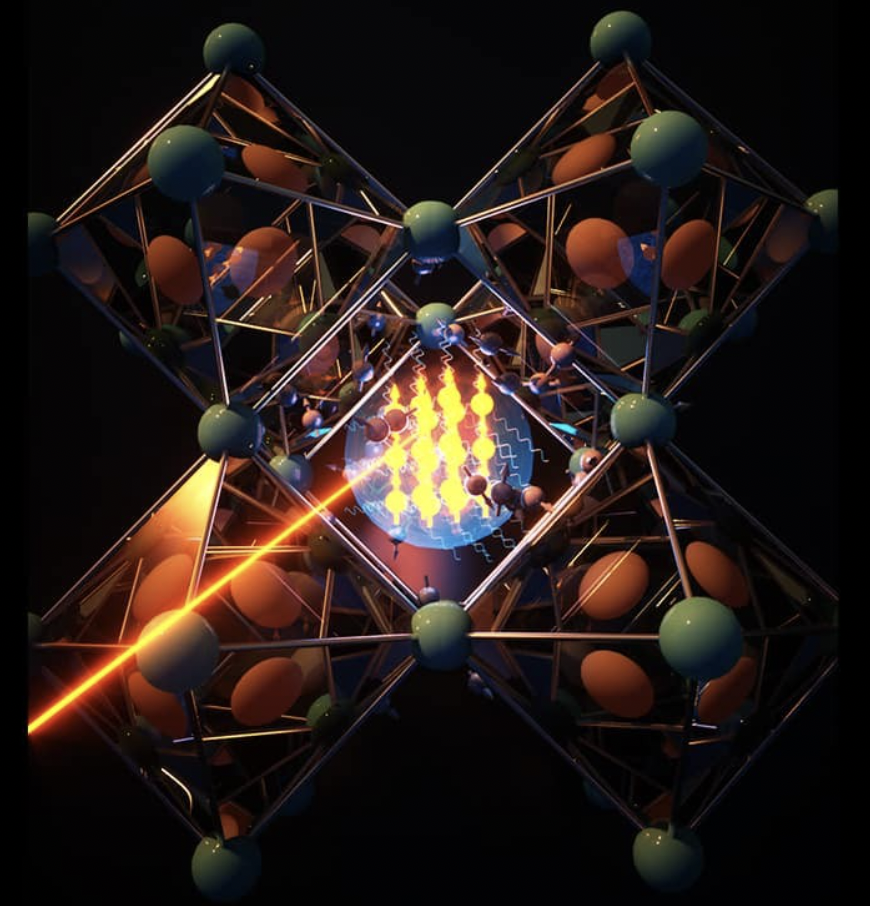
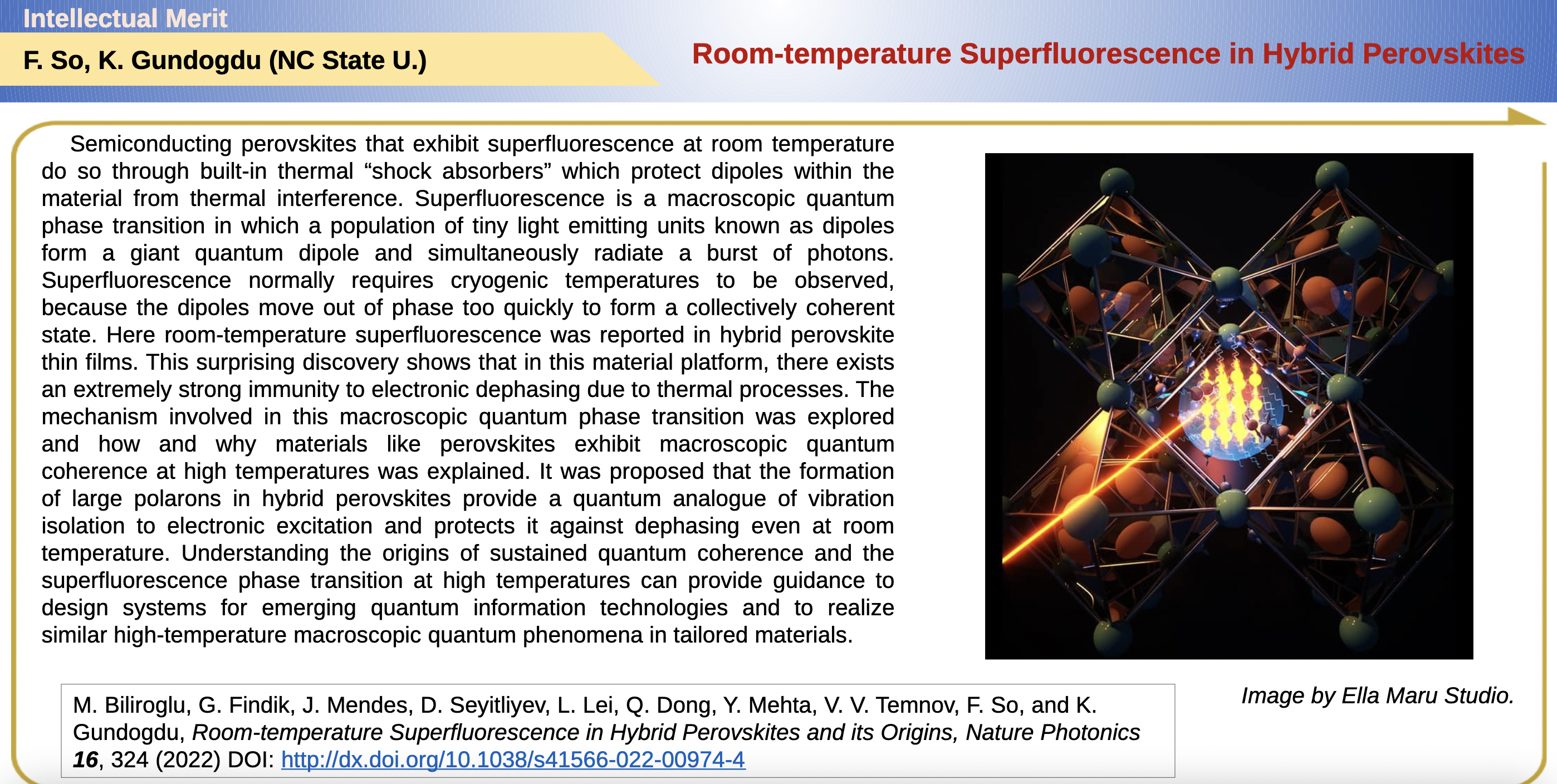
Semiconducting perovskites that exhibit superfluorescence at room temperature do so through built-in thermal “shock absorbers” which protect dipoles within the material from thermal interference. Superfluorescence is a macroscopic quantum phase transition in which a population of tiny light emitting units known as dipoles form a giant quantum dipole and simultaneously radiate a burst of photons. Superfluorescence normally requires cryogenic temperatures to be observed, because the dipoles move out of phase too quickly to form a collectively coherent state. Here room-temperature superfluorescence was reported in hybrid perovskite thin films. This surprising discovery shows that in this material platform, there exists an extremely strong immunity to electronic dephasing due to thermal processes. The mechanism involved in this macroscopic quantum phase transition was explored and how and why materials like perovskites exhibit macroscopic quantum coherence at high temperatures was explained. It was proposed that the formation of large polarons in hybrid perovskites provide a quantum analogue of vibration isolation to electronic excitation and protects it against dephasing even at room temperature. Understanding the origins of sustained quantum coherence and the superfluorescence phase transition at high temperatures can provide guidance to design systems for emerging quantum information technologies and to realize similar high-temperature macroscopic quantum phenomena in tailored materials.