A New Ultrathin Conductor for Nanoelectonics
The electrical resistivity of conventional metals such as copper is known to increase in thin films as a result of electron-surface scattering, thus limiting the performance of metals in nanoscale electronics.
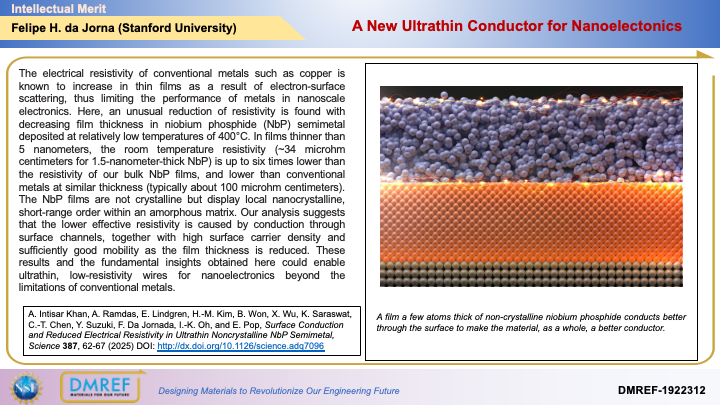
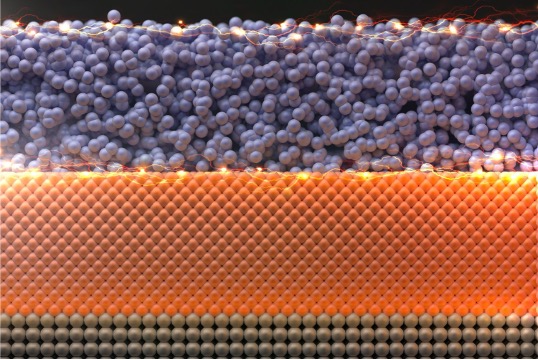
Here, an unusual reduction of resistivity is found with decreasing film thickness in niobium phosphide (NbP) semimetal deposited at relatively low temperatures of 400°C. In films thinner than 5 nanometers, the room temperature resistivity (~34 microhmcentimeters for 1.5-nanometer-thick NbP) is up to six times lower than the resistivity of our bulk NbP films, and lower than conventional metals at similar thickness (typically about 100 microhm centimeters). The NbP films are not crystalline but display local nanocrystalline, short-range order within an amorphous matrix.
Our analysis suggests that the lower effective resistivity is caused by conduction through surface channels, together with high surface carrier density and sufficiently good mobility as the film thickness is reduced. These results and the fundamental insights obtained here could enable ultrathin, low-resistivity wires for nanoelectronics beyond the limitations of conventional metals.