Excitons and Polarons in Organic Materials
Oct 20, 2020
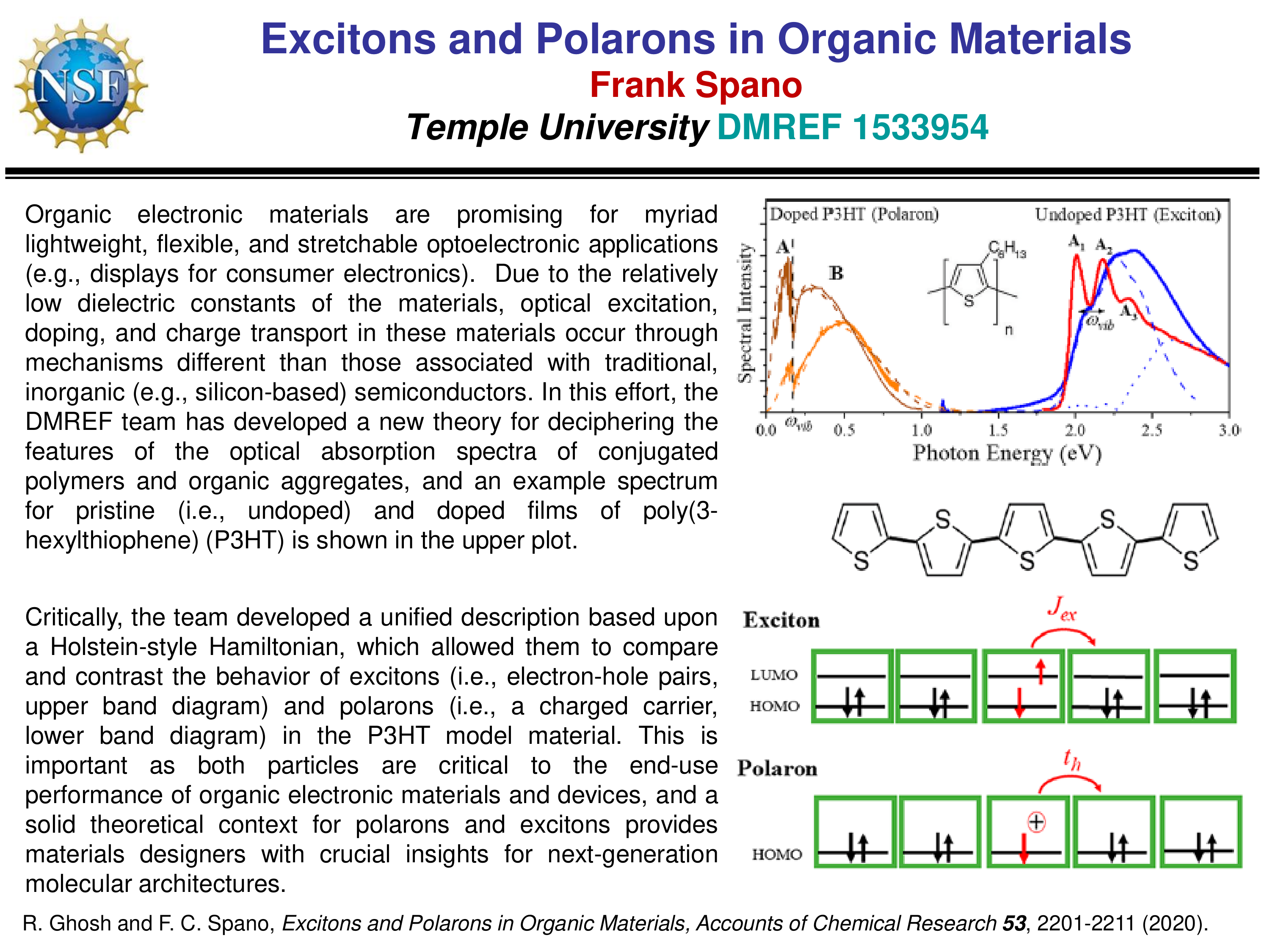
Organic electronic materials are promising for myriad lightweight, flexible, and stretchable optoelectronic applications (e.g., displays for consumer electronics). Due to the relatively low dielectric constants of the materials, optical excitation, doping, and charge transport in these materials occur through mechanisms different than those associated with traditional, inorganic (e.g., silicon-based) semiconductors. In this effort, the NSF DMREF team has developed a new theory for deciphering the features of the optical absorption spectra of conjugated polymers and organic aggregates.
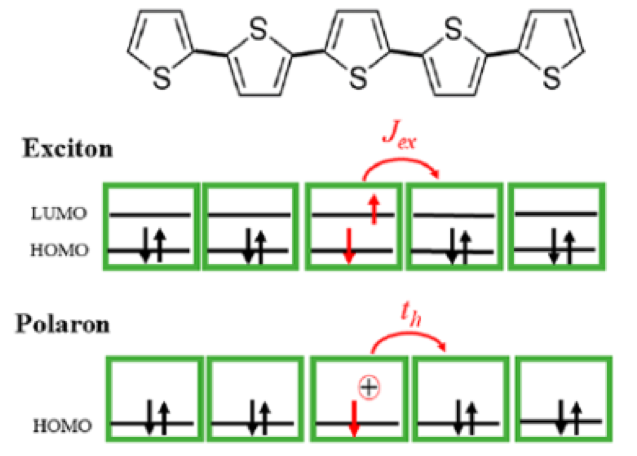
Critically, the team developed a unified description based upon a Holstein-style Hamiltonian, which allowed them to compare and contrast the behavior of excitons (i.e., electron-hole pairs) and polarons (i.e., a charged carrier) in the P3HT model material. This is important as both particles are critical to the end-use performance of organic electronic materials and devices, and a solid theoretical context for polarons and excitons provides materials designers with crucial insights for next-generation molecular architectures.