Closed-loop Design of Heterostructures for Solar Energy Conversion

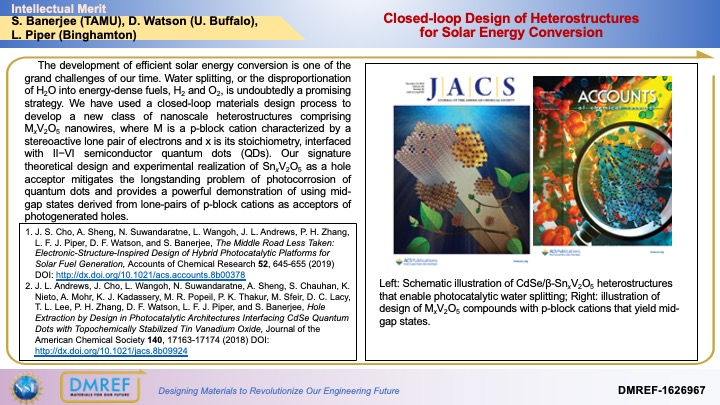
The development of efficient solar energy conversion is one of the grand challenges of our time. Water splitting, or the disproportionation of H2O into energy-dense fuels, H2 and O2, is undoubtedly a promising strategy. We have used a closed-loop materials design process to develop a new class of nanoscale heterostructures comprising MxV2O5 nanowires, where M is a p-block cation characterized by a stereoactive lone pair of electrons and x is its stoichiometry, interfaced with II−VI semiconductor quantum dots (QDs). Our signature theoretical design and experimental realization of SnxV2O5 as a hole acceptor mitigates the longstanding problem of photocorrosion of quantum dots and provides a powerful demonstration of using mid-gap states derived from lone-pairs of p-block cations as acceptors of photogenerated holes.