Data-Driven Elucidation of Solution-to- Device Feature Transfer for π‐Conjugated Polymer Semiconductors

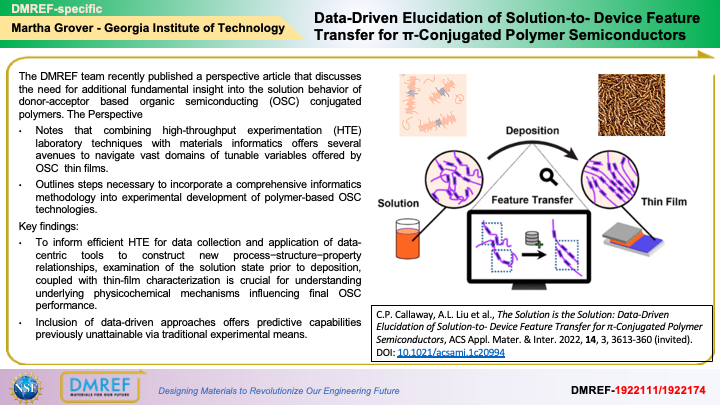
The NSF DMREF team recently published a perspective article that discusses the need for additional fundamental insight into the solution behavior of donor-acceptor based organic semiconducting (OSC) conjugated polymers.
Notes that combining high-throughput experimentation (HTE) laboratory techniques with materials informatics offers several avenues to navigate vast domains of tunable variables offered by OSC thin films.
Outlines steps necessary to incorporate a comprehensive informatics methodology into experimental development of polymer-based OSC technologies. Key findings:
To inform efficient HTE for data collection and application of data-centric tools to construct new process−structure−property relationships, examination of the solution state prior to deposition, coupled with thin-film characterization is crucial for understanding underlying physicochemical mechanisms influencing final OSC performance.
Inclusion of data-driven approaches offers predictive capabilities previously unattainable via traditional experimental means.