Glass Sponges Inspire Mechanically Robust Lattice
Feb 5, 2023
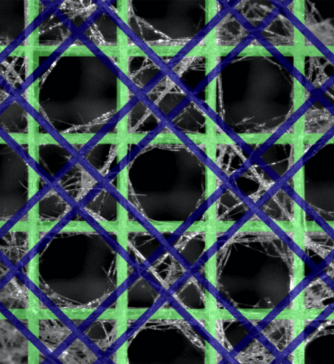
The predominantly deep-sea hexactinellid sponges are known for their ability to construct remarkably complex skeletons from amorphous hydrated silica. The skeletal system of one such species of sponge, Euplectella aspergillum, consists of a square-grid-like architecture overlaid with a double set of diagonal bracings, creating a checkerboard-like pattern of open and closed cells. Here, using a combination of finite element simulations and mechanical tests on 3D-printed specimens of different lattice geometries, we show that the sponge’s diagonal reinforcement strategy achieves the highest buckling resistance for a given amount of material.
Furthermore, using an evolutionary optimization algorithm, we show that our sponge-inspired lattice geometry approaches the optimum material distribution for the design space considered.
Through analysis of the skeletal organization of E. aspergillum, we discovered that its non-trivial, double-diagonal, checkerboard-like square lattice design provides enhanced mechanical performance compared to existing engineering structures.
The results presented here demonstrate that, by intelligently allocating material within a square lattice, it is possible to produce structures with optimal buckling resistance without the need to add more material to the system. The mechanical properties of the sponge-inspired lattice described here thus have implications for improving the performance of a wide range of truss systems, with applications ranging from large-scale infrastructure such as bridges and buildings to small-scale medical implants.
Furthermore, using an evolutionary optimization algorithm, we show that our sponge-inspired lattice geometry approaches the optimum material distribution for the design space considered.
Through analysis of the skeletal organization of E. aspergillum, we discovered that its non-trivial, double-diagonal, checkerboard-like square lattice design provides enhanced mechanical performance compared to existing engineering structures.
The results presented here demonstrate that, by intelligently allocating material within a square lattice, it is possible to produce structures with optimal buckling resistance without the need to add more material to the system. The mechanical properties of the sponge-inspired lattice described here thus have implications for improving the performance of a wide range of truss systems, with applications ranging from large-scale infrastructure such as bridges and buildings to small-scale medical implants.