Resolving Stacking Disorder in Layered Peovskites
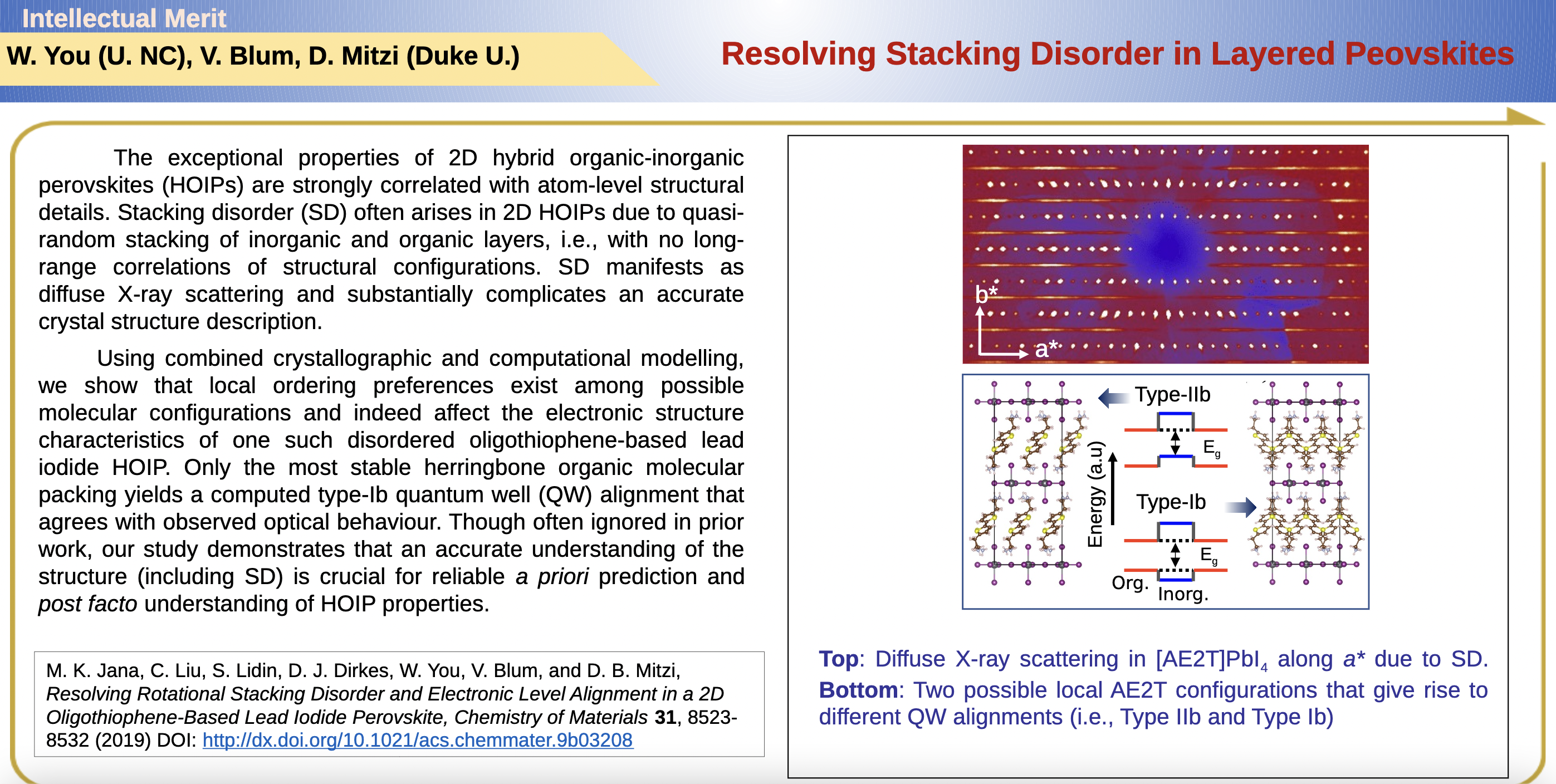
![Top: Diffuse X-ray scattering in [AE2T]PbI4 along a* due to SD. Bottom: Two possible local AE2T configurations that give rise to different QW alignments (i.e., Type IIb and Type Ib)](https://imagedelivery.net/qXYabcYg0JPsn0bBVWE4SA/ceb393f9-15cb-4e5d-93b1-294b68bfd144/Picture1.png/raw)
The exceptional properties of 2D hybrid organic-inorganic perovskites (HOIPs) are strongly correlated with atom-level structural details. Stacking disorder (SD) often arises in 2D HOIPs due to quasi-random stacking of inorganic and organic layers, i.e., with no long-range correlations of structural configurations. SD manifests as diffuse X-ray scattering and substantially complicates an accurate crystal structure description.
Using combined crystallographic and computational modelling, we show that local ordering preferences exist among possible molecular configurations and indeed affect the electronic structure characteristics of one such disordered oligothiophene-based lead iodide HOIP. Only the most stable herringbone organic molecular packing yields a computed type-Ib quantum well (QW) alignment that agrees with observed optical behaviour. Though often ignored in prior work, our study demonstrates that an accurate understanding of the structure (including SD) is crucial for reliable a priori prediction and post facto understanding of HOIP properties.