
Conductive Organic-inorganic Nanostructures
Feb 8, 2023
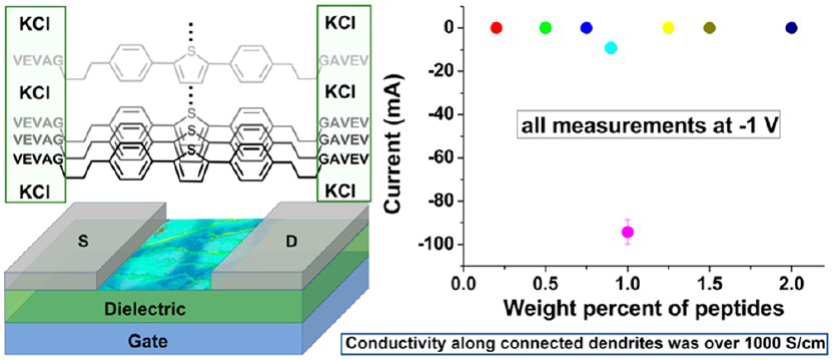
Schematic of arrangement of peptides and KCl in connected dendrites. Unusual electrical conductivity has been observed in certain compositions of mineralized peptide/p-electron nanostructures.

Dendritic structures assembled via connections between mineralizing KCl crystallites initiated by pH-triggered self-assembly of peptide materials was demonstrated. Connected structures were found to be the most important factor for producing highly conductive nanowire assemblies that showed conductivity comparable to that of a metal (~1800 S/cm).

Measurements of conductivity over time and conductivity quenching by ammonia suggested the conductivity of these dendritic networks was derived from proton doping of the central π-electron units in strong acid environment and was facilitated by closely spaced chromophores leading to facile π-electron transfer along the interconnected dendritic pathways. It is expected that more electrically relevant materials may be able to be templated through this approach.
U.S. National Science Foundation and NSF DMREF, Materials for Our Future

This material is based upon work supported by the U.S. National Science Foundation Award No. 2015237. Any opinions, findings, and conclusions or recommendations expressed in this material are those of the author(s) and do not necessarily reflect the views of the U.S. National Science Foundation. This site is maintained collaboratively by principal investigators with NSF DMREF awards, independent of the NSF.