Self-assembled Peptide-p-electron Supramolecular Polymers

Non-natural peptides containing electron-rich aromatic subunits have demonstrated the remarkable ability to spontaneously assemble into long fibers with optical and electronic responses similar toconventional silicon electronics. These molecules have the potential to serve as new biocompatible organic electronics with uses in medical interventions and clean energy.
The space of possible molecules is too vast to search by trial-and-improvement experiment, and data-driven modeling techniques can greatly accelerate the search for promising peptide designs. Computationally, we have:
developed an inexpensive molecular model assembly to identify promising new chemistries for experimental testing, and
used data-driven modeling to predict which peptide properties tend to lead to desired structures.
Experimentally, we have used the insights from this data-driven modeling and have prepared peptide sequences expected to exhibit high extents of cofacial pi-stacking. The electronic elucidation of these interactions is ongoing.
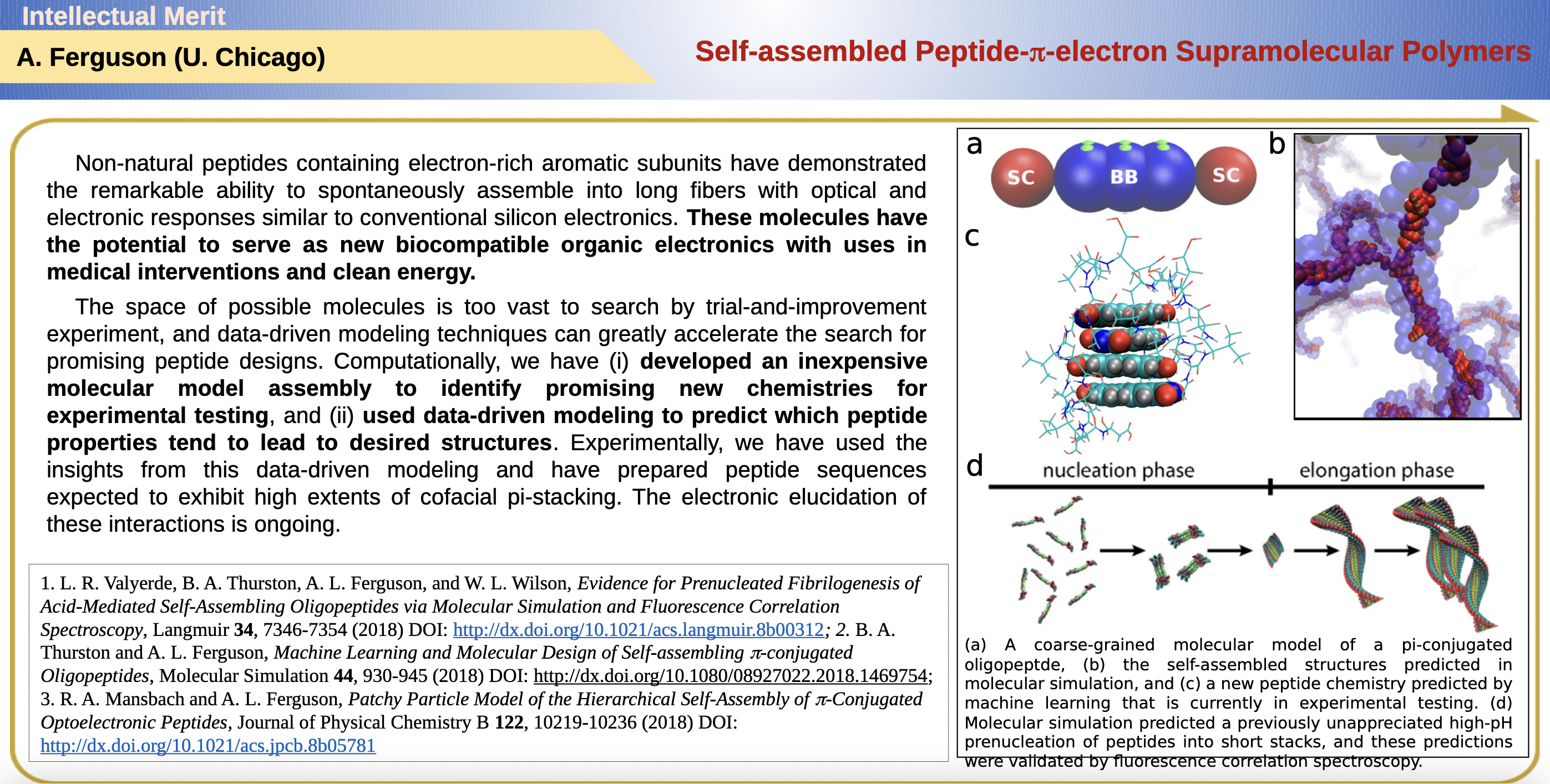
A coarse-grained molecular model of a pi-conjugated oligopeptde,
The self-assembled structures predicted in molecular simulation, and
a new peptide chemistry predicted by machine learning that is currently in experimental testing.