
Broadening Participation in Electronic Materials Research
Feb 21, 2023
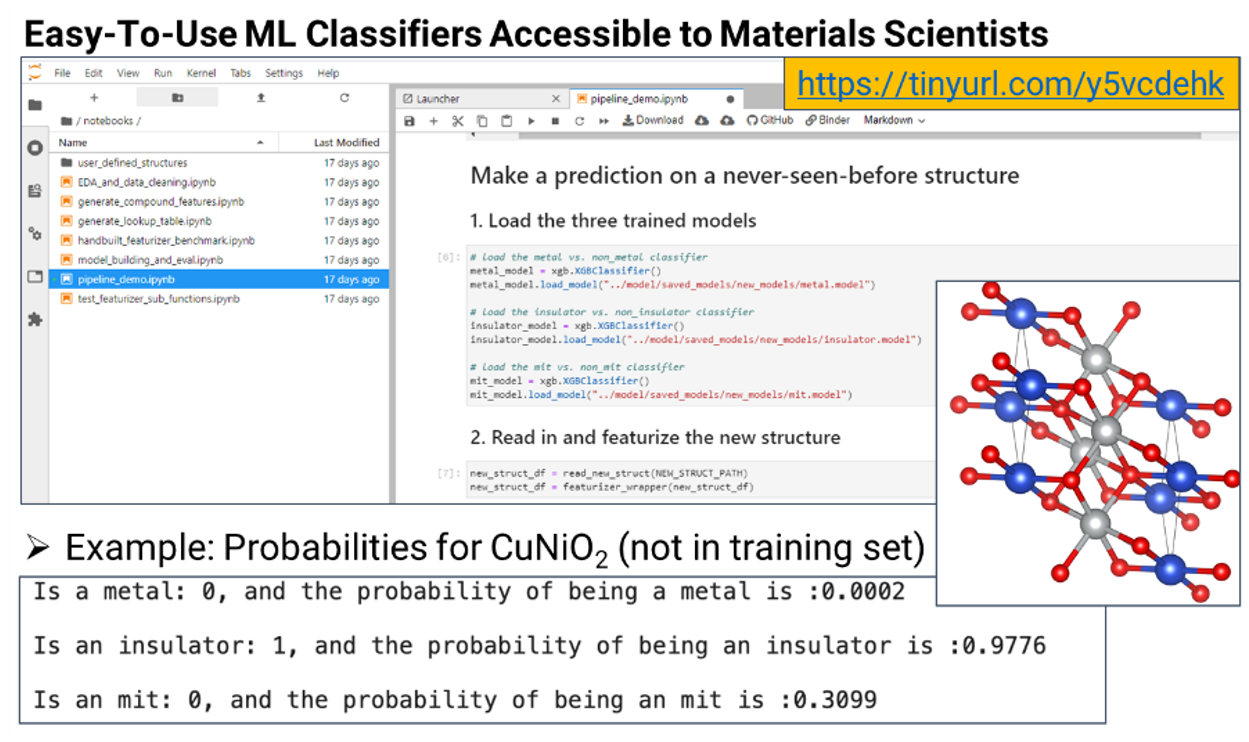
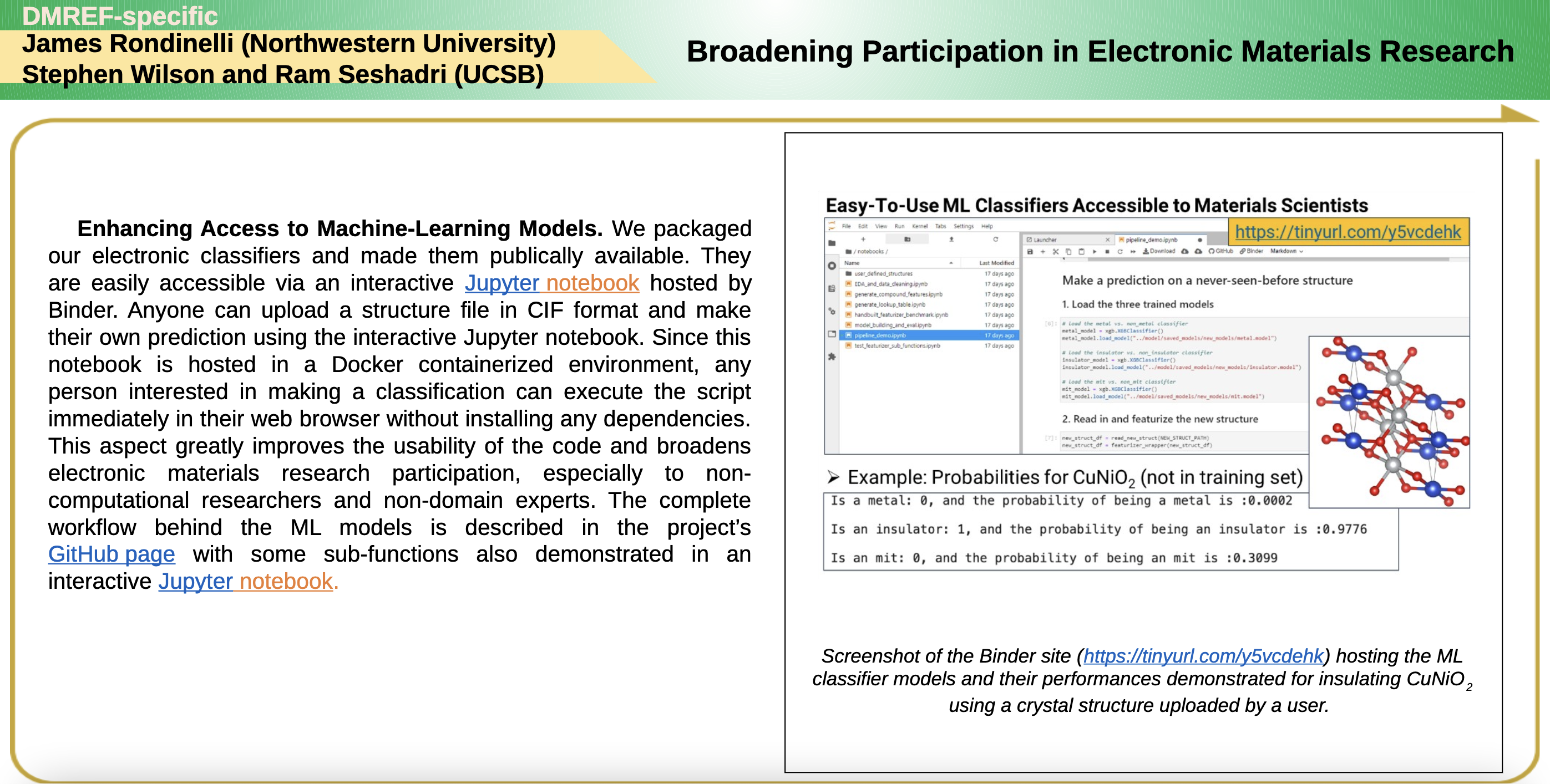
Screenshot of the Binder site (https://tinyurl.com/y5vcdehk) hosting the ML classifier models and their performances demonstrated for insulating CuNiO2 using a crystal structure uploaded by a user.

Enhancing Access to Machine-Learning Models. We packaged our electronic classifiers and made them publically available. They are easily accessible via an interactive Jupyter notebook hosted by Binder.

Anyone can upload a structure file in CIF format and make their own prediction using the interactive Jupyter notebook. Since this notebook is hosted in a Docker containerized environment, any person interested in making a classification can execute the script immediately in their web browser without installing any dependencies.

This aspect greatly improves the usability of the code and broadens electronic materials research participation, especially to non-computational researchers and non-domain experts. The complete workflow behind the ML models is described in the project’s GitHub page with some sub-functions also demonstrated in an interactive Jupyter notebook.
Authors

James Rondinelli (Northwestern University)Stephen Wilson and Ram Seshadri (UCSB)

Additional Materials

U.S. National Science Foundation and NSF DMREF, Materials for Our Future

This material is based upon work supported by the U.S. National Science Foundation Award No. 2015237. Any opinions, findings, and conclusions or recommendations expressed in this material are those of the author(s) and do not necessarily reflect the views of the U.S. National Science Foundation. This site is maintained collaboratively by principal investigators with NSF DMREF awards, independent of the NSF.