Discovery of Crystallizable Organic Semiconductors with Machine Learning
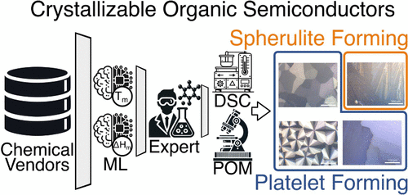
Crystalline organic semiconductors are known to have improved charge carrier mobility and exciton diffusion length in comparison to their amorphous counterparts. Certain organic molecular thin films can be transitioned from initially prepared amorphous layers to large-scale crystalline films via abrupt thermal annealing. Ideally, these films crystallize as platelets with long-range-ordered domains on the scale of tens to hundreds of microns. However, other organic molecular thin films may instead crystallize as spherulites or resist crystallization entirely.
Organic molecules that have the capability of transforming into a platelet morphology feature both high melting point (Tm) and crystallization driving force (ΔGc). In this work, machine learning (ML) was employed to identify candidate organic materials with the potential to crystallize into platelets by estimating the aforementioned thermal properties. Six organic molecules identified by the ML algorithm were experimentally evaluated; three crystallized as platelets, one crystallized as a spherulite, and two resisted thin film crystallization.
These results demonstrate a successful application of ML in the scope of predicting thermal properties of organic molecules and reinforce the principles of Tm and ΔGc as metrics that aid in predicting the crystallization behavior of organic thin films.
