
Vacuum Deposition of Nonlinear Organic Single Crystal Films on Silicon
Jul 9, 2025
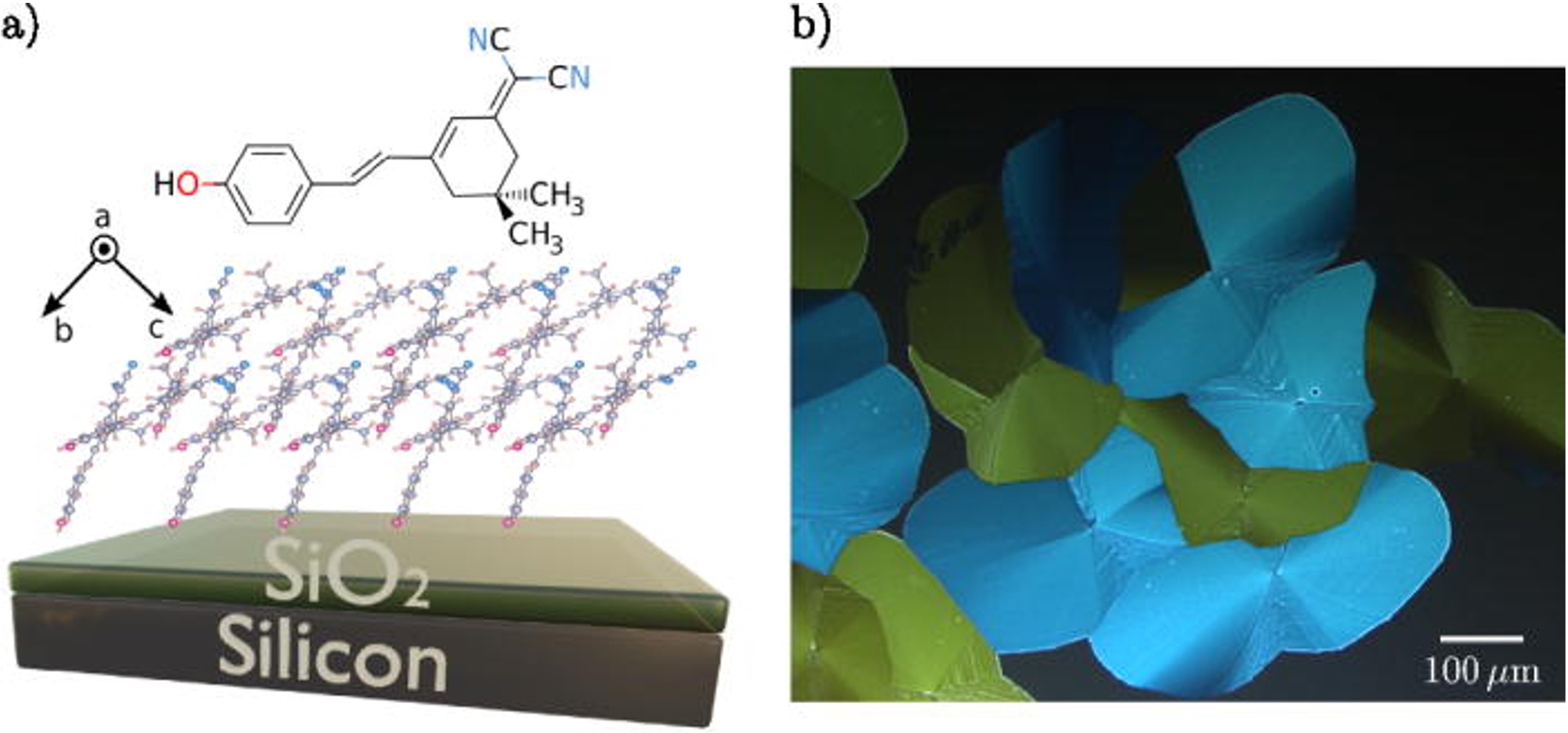
Figure. (a) Schematic showing the molecular structure of OH1 and the crystal orientation that results when it is grown and annealed on native oxide/Si. (b) Cross polarized optical microscope image of a crystallized OH1 film with large, platelet-like domains.

Integrating second order nonlinear optical materials on chip is an ongoing challenge for Si photonics. Noncentrosymmetric molecular crystals have the potential to deliver high nonlinearity with good thermal stability, but so far have been limited to growth from solution or the melt, which are both difficult to control and scale up in manufacturing.

Here, it is shown that large (>100 mm) single crystal domains of the nonlinear molecule 2-[3-(4-hydroxystyryl)-5,5-dimethylcyclohex-2-enylidene] malononitrile (OH1) can be grown monolithically on either glass or Si via vacuum evaporation, followed by a short thermal annealing step. The crystallites are tens of nanometer thick and exhibit strong second harmonic generation with their primary c(2) tensor component lying predominantly in plane. Remarkably, it was found that a single domain can grow uninterrupted through nearby channels etched on a Si wafer, which may provide a path to integrate OH1 on Si or Si3N4 waveguides for a broad range of c(2) -based photonic integrated circuit functionality.

Publication

Authors

Noa Marom (Carnegie Mellon U.), Noel Giebink (U. Michigan), Barry Rand (Princeton)

Additional Materials

U.S. National Science Foundation and NSF DMREF, Materials for Our Future

This material is based upon work supported by the U.S. National Science Foundation Award No. 2015237. Any opinions, findings, and conclusions or recommendations expressed in this material are those of the author(s) and do not necessarily reflect the views of the U.S. National Science Foundation. This site is maintained collaboratively by principal investigators with NSF DMREF awards, independent of the NSF.