Stabilizing Graphite Anode in Electrolytes with Nanoscale Anion Networking for High-Rate Lithium Storage

Graphite is the preferred anode material in commercial lithium-ion batteries (LIBs), but its limited compatibility with various organic molecules restricts the electrolyte solvent options. The primary challenge is solvent co-intercalation with Li ions, leading to graphite layer exfoliation. As a result, electrolyte selection often relies on ethylene carbonate (EC)-based solvents.
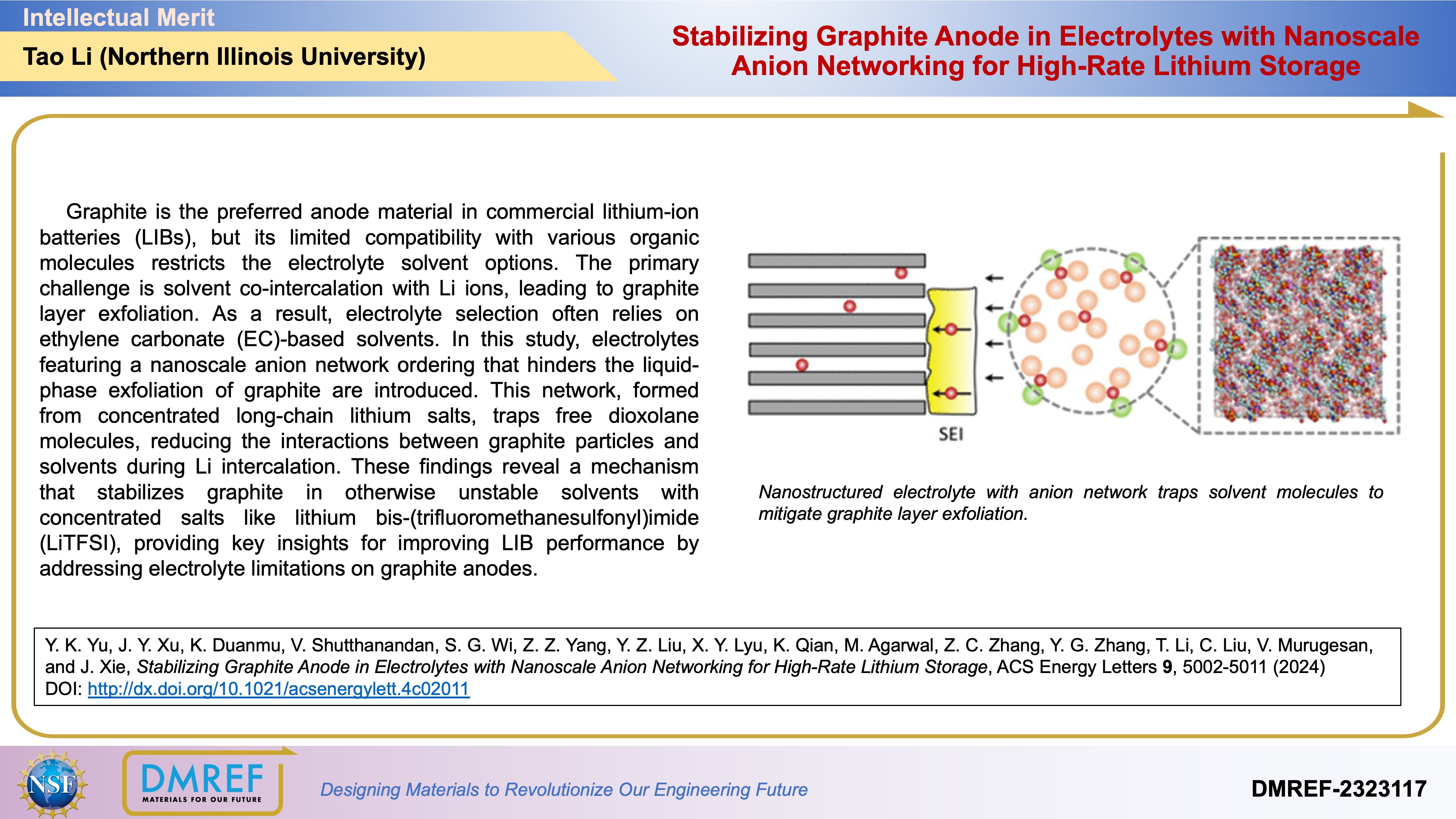
In this study, electrolytes featuring a nanoscale anion network ordering that hinders the liquid-phase exfoliation of graphite are introduced. This network, formed from concentrated long-chain lithium salts, traps free dioxolane molecules, reducing the interactions between graphite particles and solvents during Li intercalation.
These findings reveal a mechanism that stabilizes graphite in otherwise unstable solvents with concentrated salts like lithium bis-(trifluoromethanesulfonyl)imide (LiTFSI), providing key insights for improving LIB performance by addressing electrolyte limitations on graphite anodes.