Designing Optical Materials Emit Chiral Light using Small-molecule Ionic Isolthatation Lattices (SMILES)
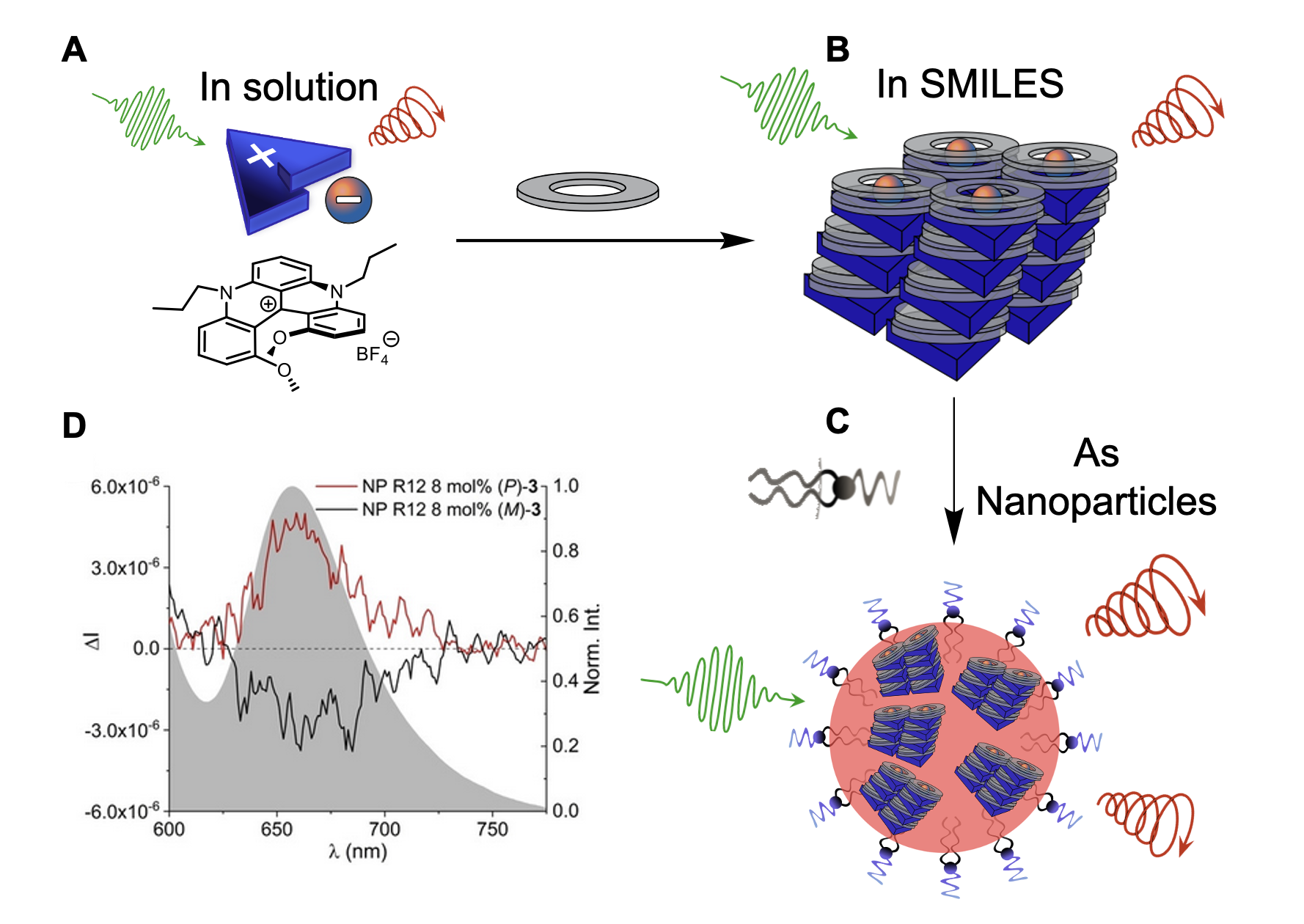
A major goal of creating optical materials is to design them from the bottom up. Here, this is done using small-molecule, ionic isolation lattices (SMILES) that allow synthetically crafted dyes to be transferred all the way from conception through to a material. The ability to emit light in the form of circularly polarized luminescence (CPL) was demonstrated using a “helicene” dye that is self-assembled into SMILES materials as crystals, and as SMILES nanoparticles.
The result of this paper is in the creation of SMILES crystals and nanoparticles that can produce CPL with chiral dissymmetry factors (the figure of merit in CPL) that are as high or higher than those observed in solution studies.
The significance of this work is the transfer of optical chirality from solution to solids, aka, from atoms to materials. This work has implications in several important areas including 3D display technology and bioimaging. The future of this work will rely on more advanced dyes and crystal engineering in SMILES assemblies.
