Big-data Explorations for Small-molecule, Ionic Isolation Lattices (SMILES)

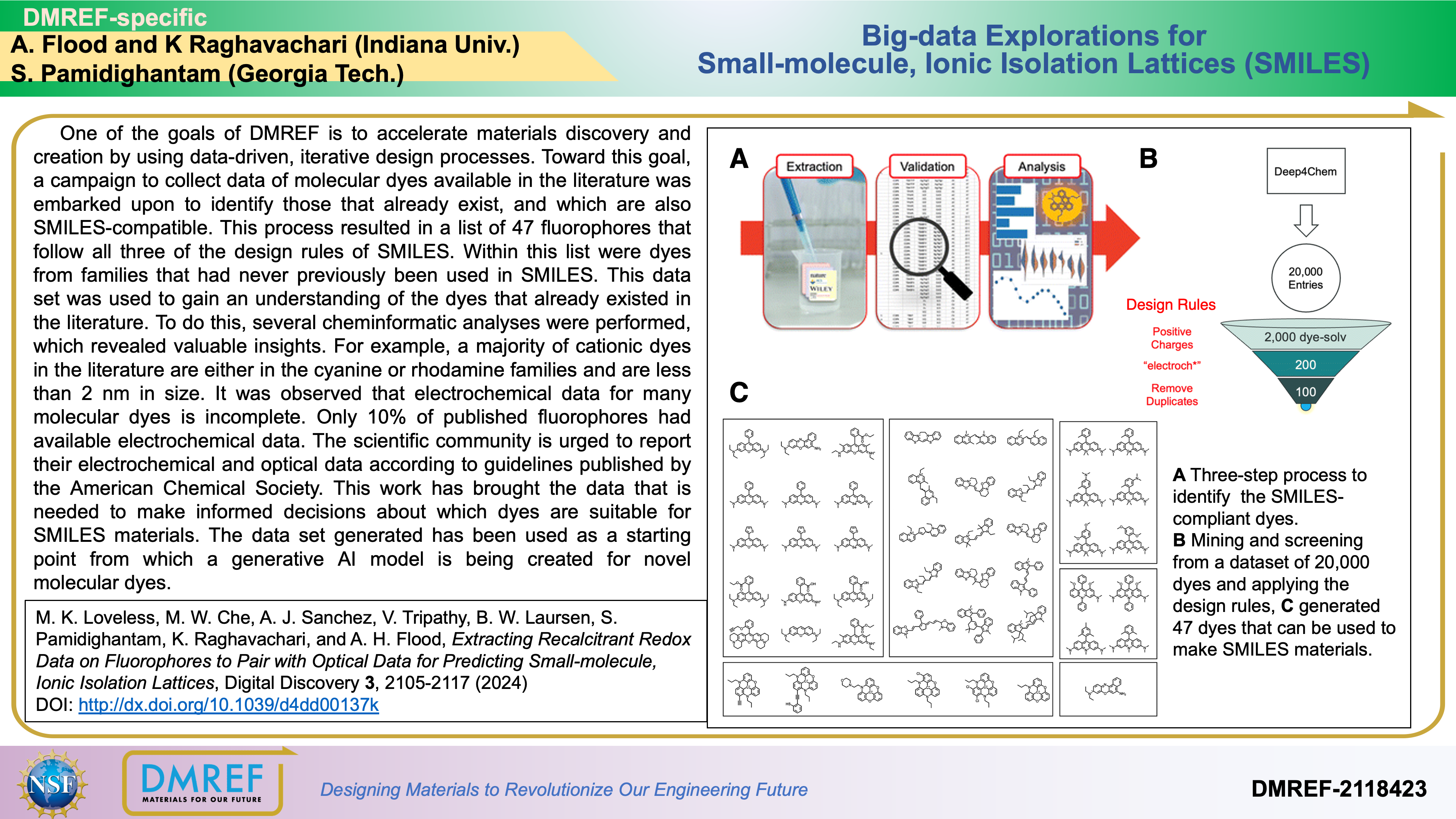
One of the goals of NSF DMREF is to accelerate materials discovery and creation by using data-driven, iterative design processes. Toward this goal, a campaign to collect data of molecular dyes available in the literature was embarked upon to identify those that already exist, and which are also SMILES-compatible.
This process resulted in a list of 47 fluorophores that follow all three of the design rules of SMILES. Within this list were dyes from families that had never previously been used in SMILES. This data set was used to gain an understanding of the dyes that already existed in the literature. To do this, several cheminformatic analyses were performed, which revealed valuable insights.
For example, a majority of cationic dyes in the literature are either in the cyanine or rhodamine families and are less than 2 nm in size. It was observed that electrochemical data for many molecular dyes is incomplete. Only 10% of published fluorophores had available electrochemical data. The scientific community is urged to report their electrochemical and optical data according to guidelines published by the American Chemical Society.
This work has brought the data that is needed to make informed decisions about which dyes are suitable for SMILES materials. The data set generated has been used as a starting point from which a generative AI model is being created for novel molecular dyes.