Design and Discovery of Organic Semiconductors Aided by Machine Learning

Organic semiconductors (OSCs) offer the capacity for distinctive and finely tuned electronic, optical, thermal, and mechanical properties, making them of interest across a range of energy generation and storage, sensor, lighting, display, and electronics applications. The pathway from molecular building block design to material, however, is complicated by complex synthesis–processing–structure–property–function relationships that are inherent to OSCs.
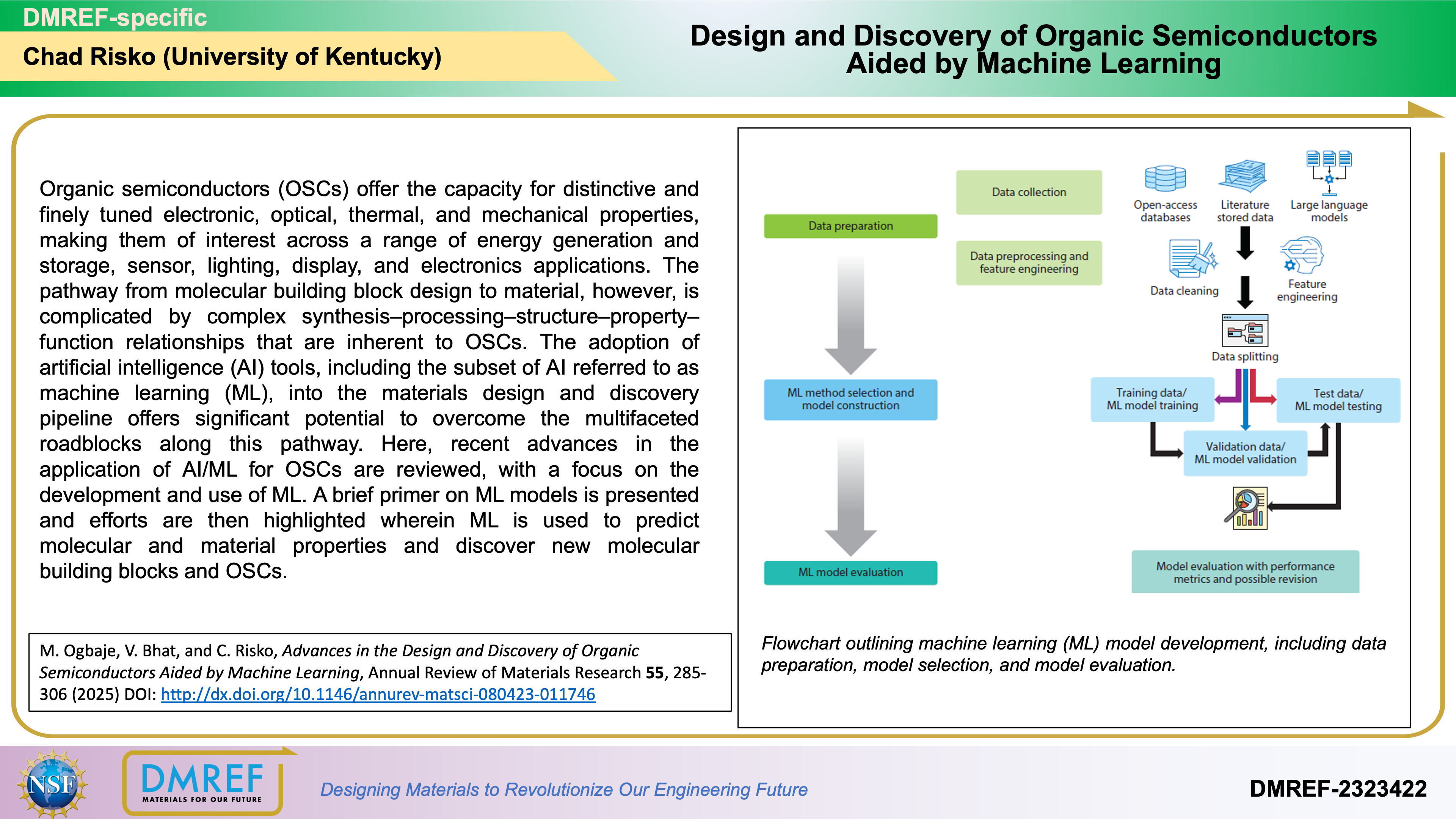
The adoption of artificial intelligence (AI) tools, including the subset of AI referred to as machine learning (ML), into the materials design and discovery pipeline offers significant potential to overcome the multifaceted roadblocks along this pathway. Here, recent advances in the application of AI/ML for OSCs are reviewed, with a focus on the development and use of ML. A brief primer on ML models is presented and efforts are then highlighted wherein ML is used to predict molecular and material properties and discover new molecular building blocks and OSCs.