
Reinforcement Learning-guided Long-timescale Simulation of Hydrogen Transport in Metals
Aug 20, 2025
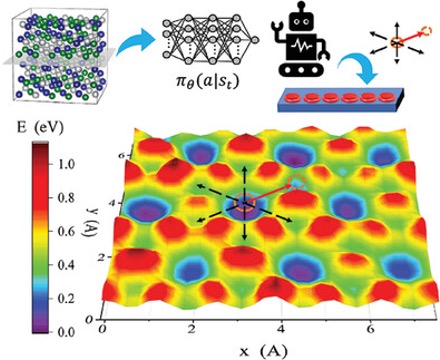
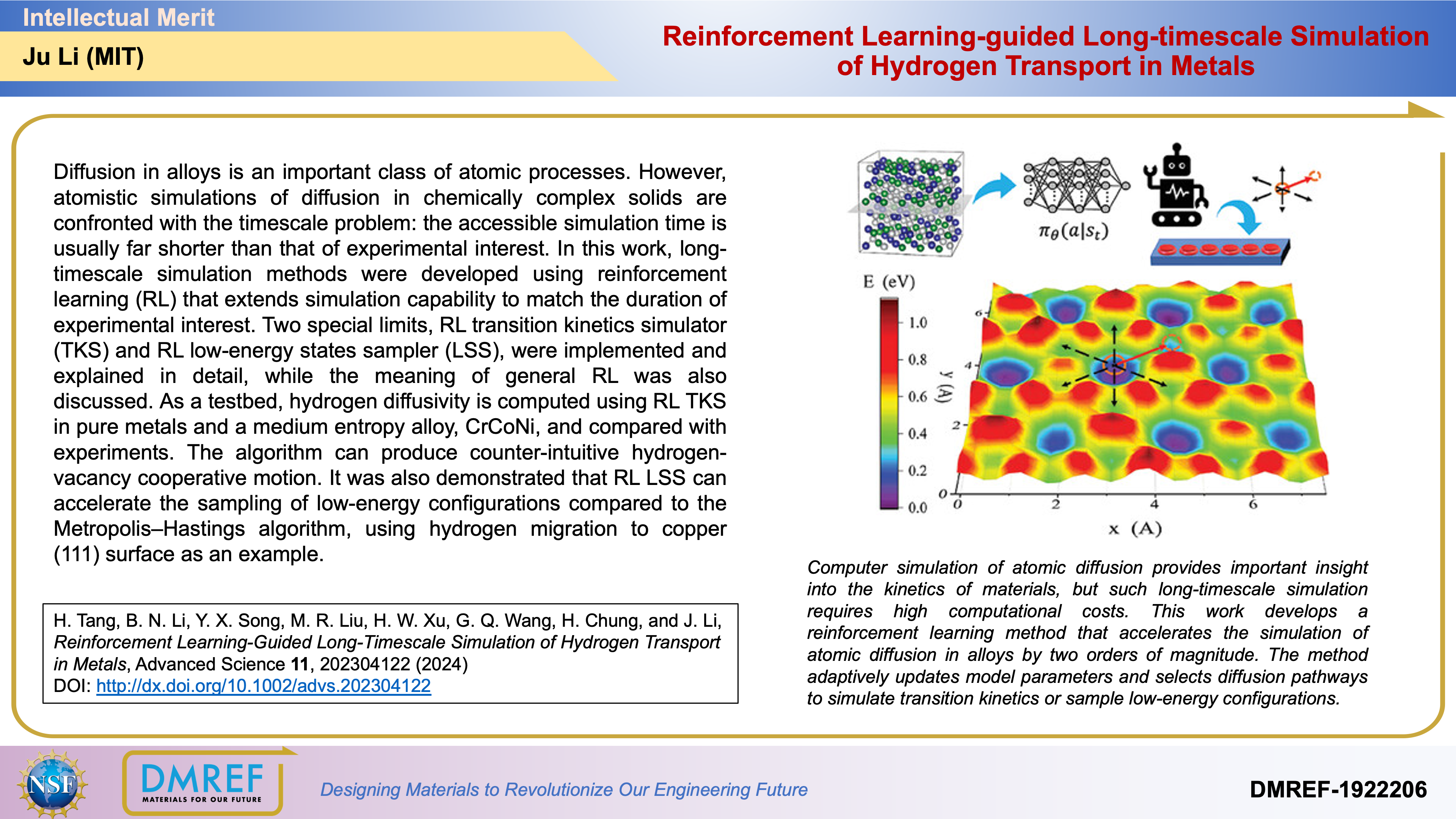
Computer simulation of atomic diffusion provides important insight into the kinetics of materials, but such long-timescale simulation requires high computational costs. This work develops a reinforcement learning method that accelerates the simulation of atomic diffusion in alloys by two orders of magnitude. The method adaptively updates model parameters and selects diffusion pathways to simulate transition kinetics or sample low-energy configurations.

Diffusion in alloys is an important class of atomic processes. However, atomistic simulations of diffusion in chemically complex solids are confronted with the timescale problem: the accessible simulation time is usually far shorter than that of experimental interest.

In this work, long-timescale simulation methods were developed using reinforcement learning (RL) that extends simulation capability to match the duration of experimental interest. Two special limits, RL transition kinetics simulator (TKS) and RL low-energy states sampler (LSS), were implemented and explained in detail, while the meaning of general RL was also discussed.

As a testbed, hydrogen diffusivity is computed using RL TKS in pure metals and a medium entropy alloy, CrCoNi, and compared with experiments. The algorithm can produce counter-intuitive hydrogen-vacancy cooperative motion. It was also demonstrated that RL LSS can accelerate the sampling of low-energy configurations compared to the Metropolis–Hastingsalgorithm, using hydrogen migration to copper (111) surface as an example.
U.S. National Science Foundation and NSF DMREF, Materials for Our Future

This material is based upon work supported by the U.S. National Science Foundation Award No. 2015237. Any opinions, findings, and conclusions or recommendations expressed in this material are those of the author(s) and do not necessarily reflect the views of the U.S. National Science Foundation. This site is maintained collaboratively by principal investigators with NSF DMREF awards, independent of the NSF.