
Field-free Deterministic Switching of all-van der Waals Spin-orbit Torque System Above Room Temperature
Aug 22, 2025
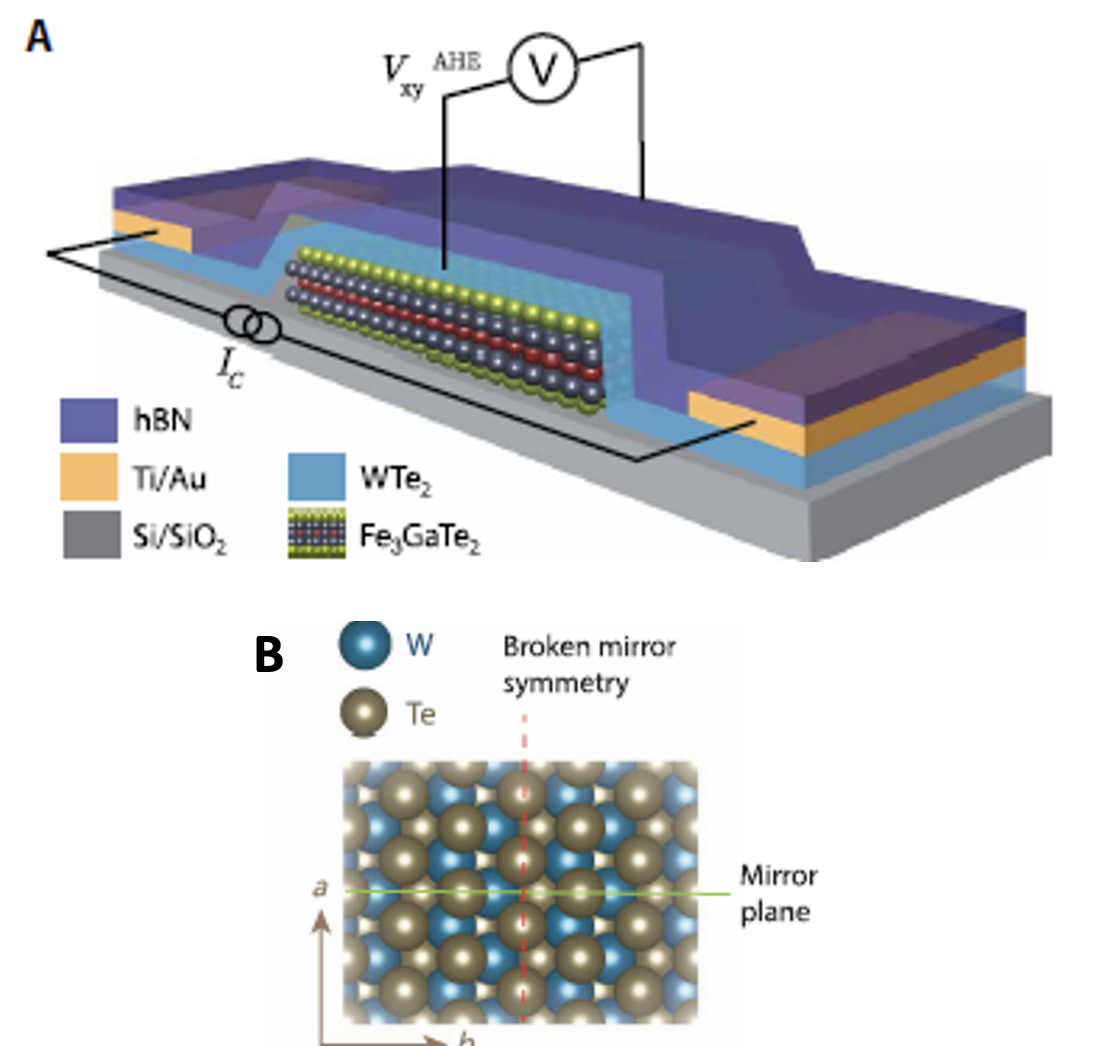
FGaT/WTe2 heterostructure device. (A) Schematic diagram of the FGaT/WTe2 heterostructure devices used in this study. (B) Schematic model of WTe2 crystal’s ab plane, with the a and b axes labeled. The crystal preserves mirror-plane symmetry in the bc plane but breaks it in the ac plane.

Two-dimensional van der Waals (vdW) magnetic materials hold promise for the development of high-density, energy-efficient spintronic devices for memory and computation. Recent breakthroughs in material discoveries and spin-orbit torque control of vdW ferromagnets have opened a path for integration of vdW magnets in commercial spintronic devices.

However, a solution for field-free electric control of perpendicular magnetic anisotropy (PMA) vdW magnets at room temperatures, essential for building compact and thermally stable spintronic devices, is still missing. Here, a solution for the field-free, deterministic, and nonvolatile switching of a PMA vdW ferromagnet, Fe3GaTe2, is reported above room temperature (up to 320 K).

This study exemplifies the efficacy of low-symmetry vdW materials for spin-orbit torque control of vdW ferromagnets and provides an all-vdW solution for the next generation of scalable and energy-efficient spintronic devices.
U.S. National Science Foundation and NSF DMREF, Materials for Our Future

This material is based upon work supported by the U.S. National Science Foundation Award No. 2015237. Any opinions, findings, and conclusions or recommendations expressed in this material are those of the author(s) and do not necessarily reflect the views of the U.S. National Science Foundation. This site is maintained collaboratively by principal investigators with NSF DMREF awards, independent of the NSF.