Predicting and Accelerating Nanomaterials Synthesis using Machine Learning Featurization

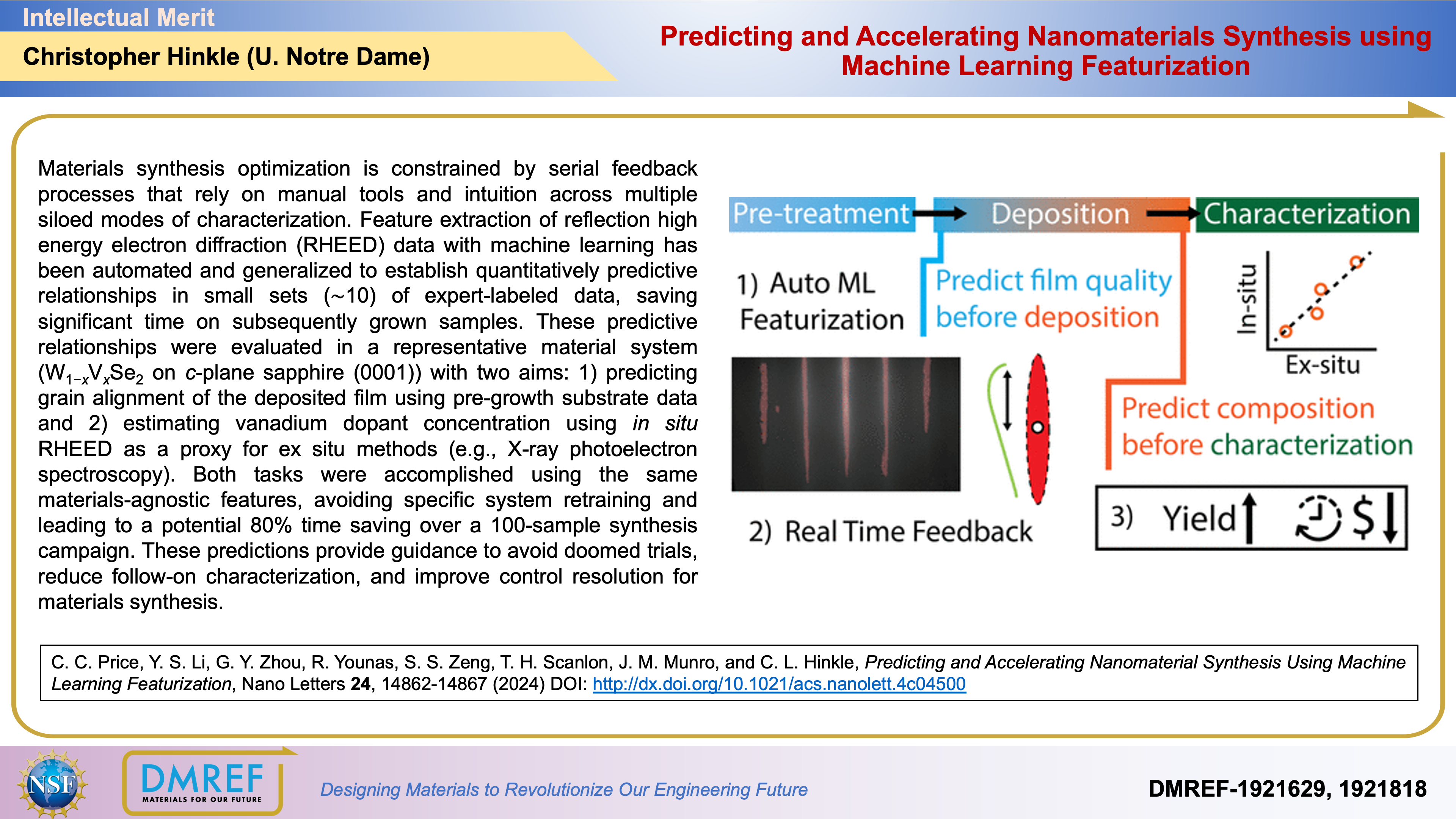
Materials synthesis optimization is constrained by serial feedback processes that rely on manual tools and intuition across multiple siloed modes of characterization. Feature extraction of reflection high energy electron diffraction (RHEED) data with machine learning has been automated and generalized to establish quantitatively predictive relationships in small sets (∼10) of expert-labeled data, saving significant time on subsequently grown samples.
These predictive relationships were evaluated in a representative material system (W1−xVxSe2 on c-plane sapphire (0001)) with two aims: 1) predicting grain alignment of the deposited film using pre-growth substrate data and 2) estimating vanadium dopant concentration using in situ RHEED as a proxy for ex situ methods (e.g., X-ray photoelectron spectroscopy). Both tasks were accomplished using the same materials-agnostic features, avoiding specific system retraining and leading to a potential 80% time saving over a 100-sample synthesis campaign.
These predictions provide guidance to avoid doomed trials, reduce follow-on characterization, and improve control resolution for materials synthesis.