Energy Transfer Mechanisms in Large Low-bandgap Polymers

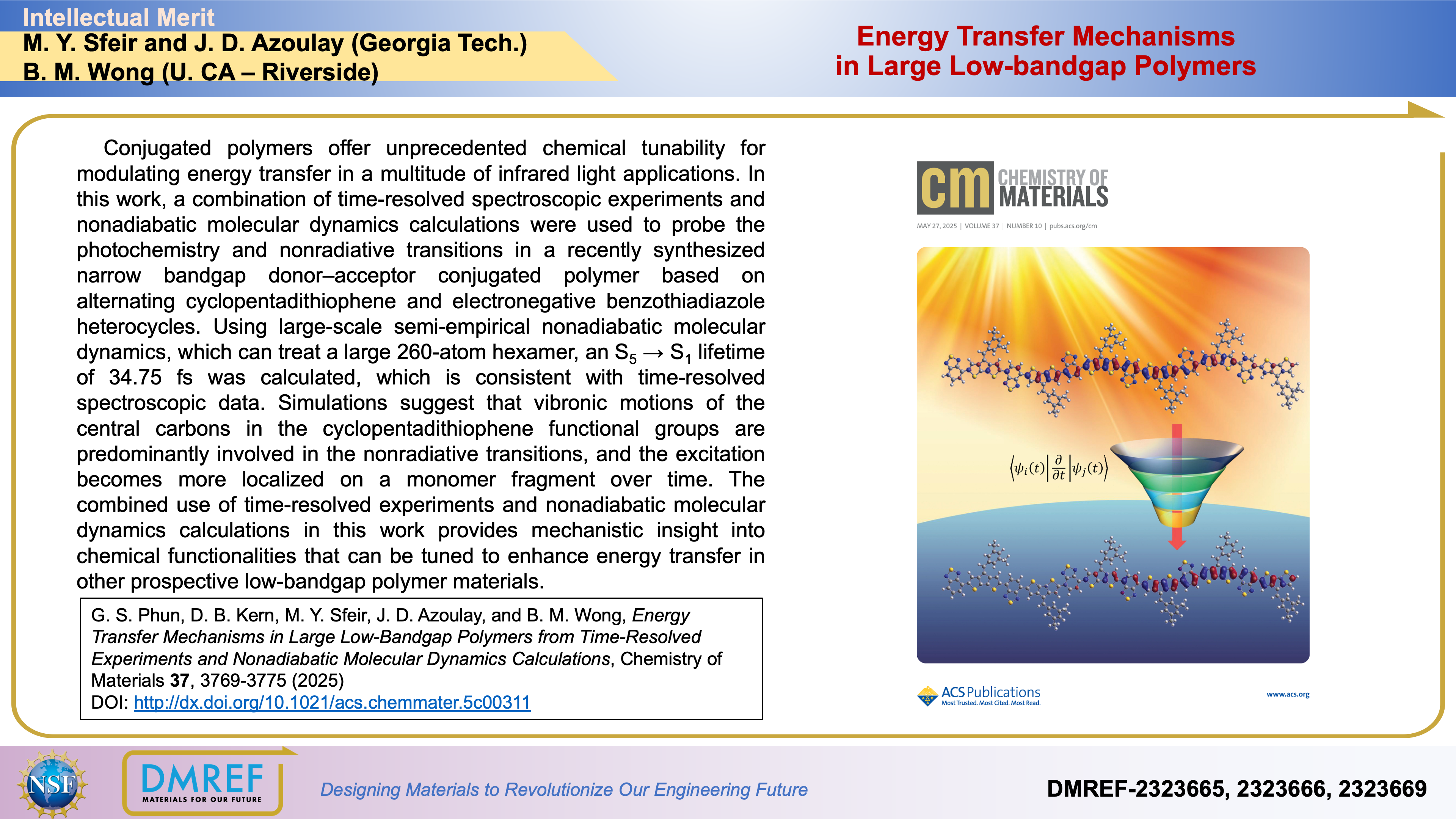
Conjugated polymers offer unprecedented chemical tunability for modulating energy transfer in a multitude of infrared light applications. In this work, a combination of time-resolved spectroscopic experiments and nonadiabatic molecular dynamics calculations were used to probe the photochemistry and nonradiative transitions in a recently synthesized narrow bandgap donor–acceptor conjugated polymer based on alternating cyclopentadithiophene and electronegative benzothiadiazole heterocycles.
Using large-scale semi-empirical nonadiabatic molecular dynamics, which can treat a large 260-atom hexamer, an S5 → S1 lifetime of 34.75 fs was calculated, which is consistent with time-resolved spectroscopic data. Simulations suggest that vibronic motions of the central carbons in the cyclopentadithiophene functional groups are predominantly involved in the nonradiative transitions, and the excitation becomes more localized on a monomer fragment over time.
The combined use of time-resolved experiments and nonadiabatic molecular dynamics calculations in this work provides mechanistic insight into chemical functionalities that can be tuned to enhance energy transfer in other prospective low-bandgap polymer materials.