
A Bioinspired and Degradable Riboflavin-containing Polypeptide as a Sustainable Material for Energy Storage
Nov 18, 2025
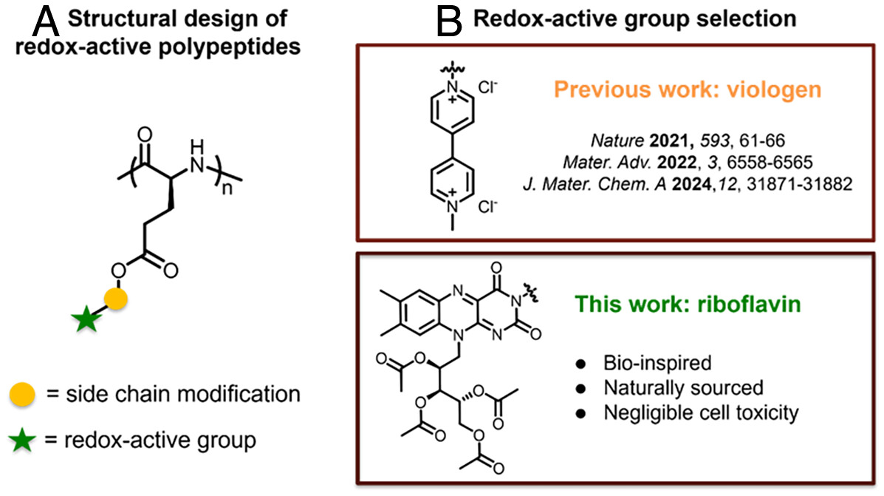
A) Structural design of polypeptides carrying redox-active pendant groups. (B) Riboflavin was selected as a potential electroactive alternative to viologen to enhance the sustainability and biocompatibility of the resulting redox-active polypeptide.

Sustainable energy storage materials can address environmental, safety, security, and ethical issues associated with conventional battery platforms. Herein, the design of redox-active polypeptide materials was advanced by incorporating riboflavin, a biological redox cofactor, as redox-active pendant groups on a hydrolytically degradable polyglutamate backbone.

This design retains the polypeptide backbone architecture while introducing renewable side-chain functionality, enabling the construction of a biologically sourced organic battery material. The resulting design improved sustainability, minimized cytotoxicity, and demonstrated effective degradability under hydrolytic conditions. By decoupling redox activity from fossil-based feedstocks or metals, this bioinspired strategy introduces a class of environmentally friendly materials for next-generation energy storage systems (ESSs).
Authors

Jodie Lutkenhaus (Texas A&M University)

Additional Materials

U.S. National Science Foundation and NSF DMREF, Materials for Our Future

This material is based upon work supported by the U.S. National Science Foundation Award No. 2015237. Any opinions, findings, and conclusions or recommendations expressed in this material are those of the author(s) and do not necessarily reflect the views of the U.S. National Science Foundation. This site is maintained collaboratively by principal investigators with NSF DMREF awards, independent of the NSF.