Toward an Interoperable Perovskite Description
Dec 1, 2025
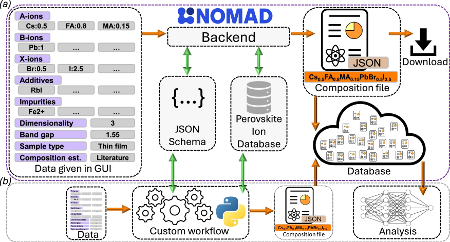
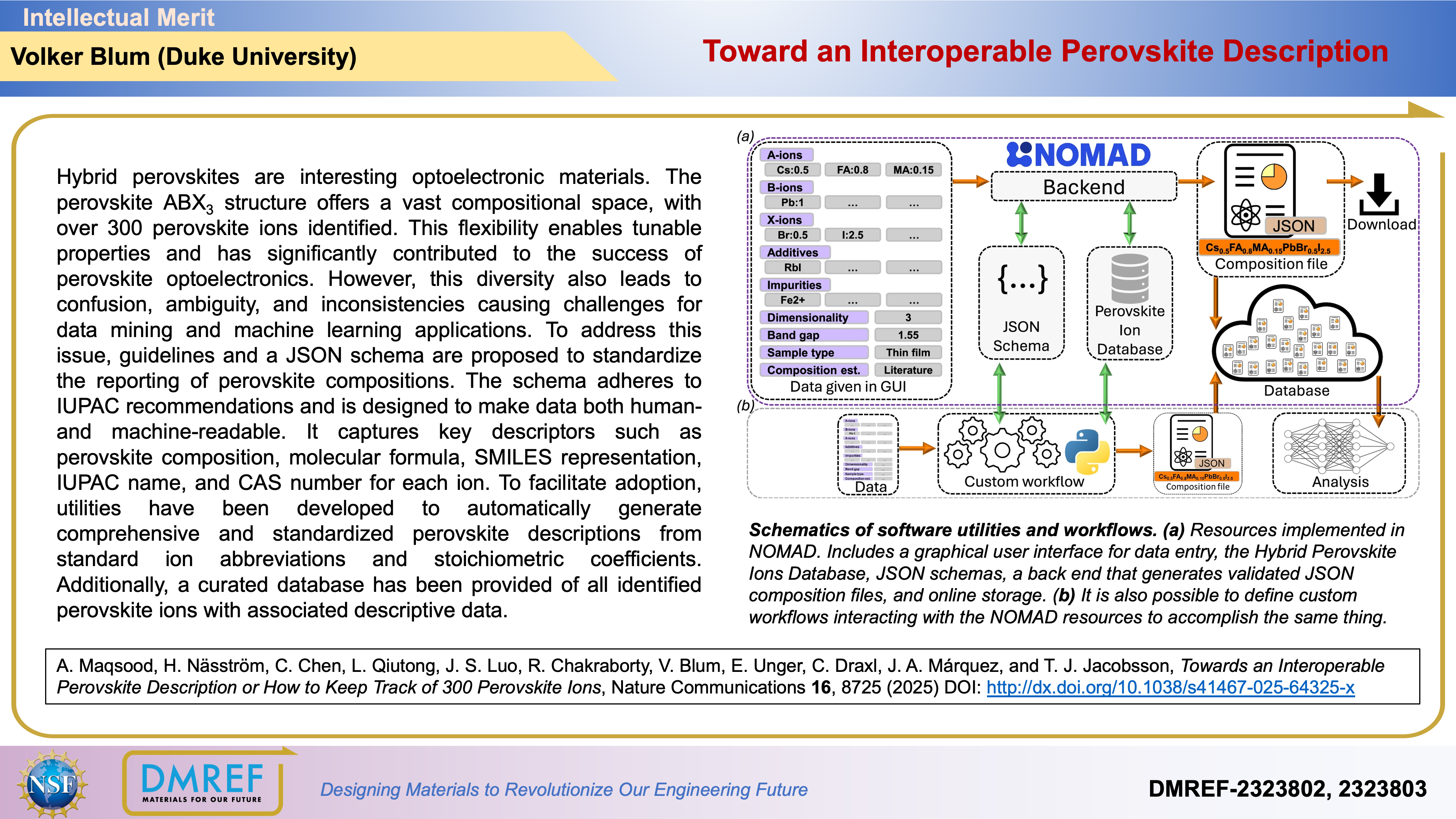
Schematics of software utilities and workflows. (a) Resources implemented in NOMAD. Includes a graphical user interface for data entry, the Hybrid Perovskite Ions Database, JSON schemas, a back end that generates validated JSON composition files, and online storage. (b) It is also possible to define custom workflows interacting with the NOMAD resources to accomplish the same thing.

Hybrid perovskites are interesting optoelectronic materials. The perovskite ABX3 structure offers a vast compositional space, with over 300 perovskite ions identified. This flexibility enables tunable properties and has significantly contributed to the success of perovskite optoelectronics. However, this diversity also leads to confusion, ambiguity, and inconsistencies causing challenges for data mining and machine learning applications.

To address this issue, guidelines and a JSON schema are proposed to standardize the reporting of perovskite compositions. The schema adheres to IUPAC recommendations and is designed to make data both human- and machine-readable. It captures key descriptors such as perovskite composition, molecular formula, SMILES representation, IUPAC name, and CAS number for each ion. To facilitate adoption, utilities have been developed to automatically generate comprehensive and standardized perovskite descriptions from standard ion abbreviations and stoichiometric coefficients. Additionally, a curated database has been provided of all identified perovskite ions with associated descriptive data.
Authors

Volker Blum (Duke University)

Additional Materials

NSF Logo

Any opinions, findings, and conclusions or recommendations expressed on this website are those of the participants and do not necessarily reflect the views of the National Science Foundation or the participating institutions. This site is maintained collaboratively by principal investigators with Designing Materials to Revolutionize and Engineer our Future awards, independent of the NSF.

DMREF Logo