Prediction of Carbon Nanostructure Mechanical Properties and the Role of Defects using Machine Learning
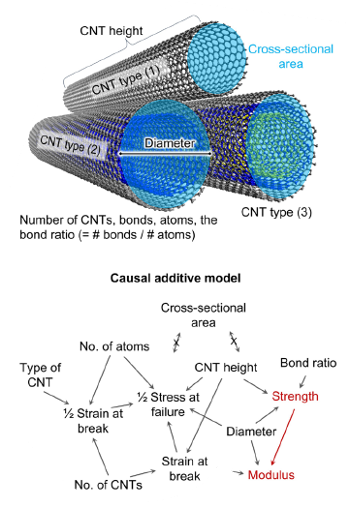
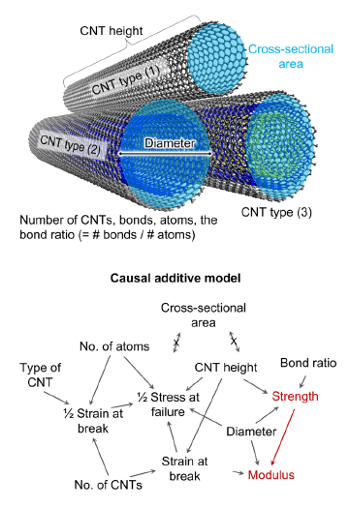
A database was introduced of over 2,000 dynamic stress–strain curves and failure properties of 3D carbon nanostructures for real-time predictions of elastic and failure properties using machine learning (ML). The models cover defective carbon nanotube (CNT) bundles, carbon fiber cross-sections, and carbon nanotube junctions up to eighty thousand atoms and predict mechanical properties up to 10,000 times faster than current molecular dynamics simulations with mean relative errors under 5%. Graph-based machine learning algorithms were developed and compared to existing ML methods, showing promise of physics- and chemistry-based hierarchical graph-based models to perform well for sparse data and structures out of the training range. Potential applications include ML-accelerated defect engineering and design of carbon nanostructures, structural materials, catalysts, and nanoscale electronics.