Predicting Process-Microstructure Relationship in Fusion-based Metal Additive Manufacturing
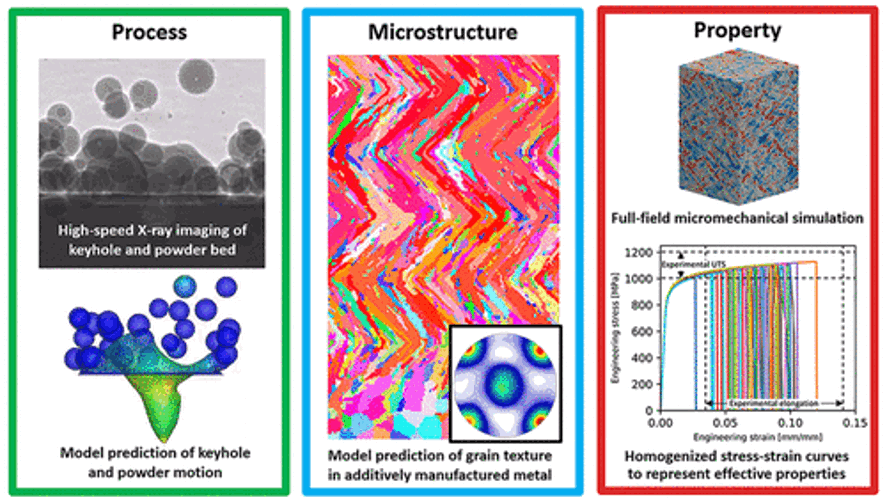
Additive Manufacturing (AM) technology produces three-dimensional components in a layer-by-layer fashion and offers numerous advantages over conventional manufacturing processes. Driven by the growing needs of diverse industrial sectors, this technology has seen significant advances on both scientific and engineering fronts. Fusion-based processes are the mainstream techniques for AM of metallic materials. As the metals go through melting and solidification during the printing processes, the final microstructure and hence the properties of the printed components are highly sensitive to the printing conditions and can be very different from those of the feedstock. It is critical to understand the process-microstructure-property relationship for the accelerated optimization of the processing conditions and certification of the printed components. While experimentation has been used widely to acquire a mechanistic understanding of this subject matter, numerical modeling has become increasingly helpful in achieving the same purpose. Here, the authors review their ongoing collaborative effort to establish a multiphysics modeling framework to predict the process-microstructure-property relationship in fusion-based metal AM processes. The framework includes three individual modules to simulate the dominating physics that dictate the process dynamics and microstructure evolution during printing as well as the responses of the printed microstructure to specific mechanical loadings.
