Interface-Tuning of Ferroelectricity and Quadruple-Well State in CuInP2S6 via Ferroelectric Oxide

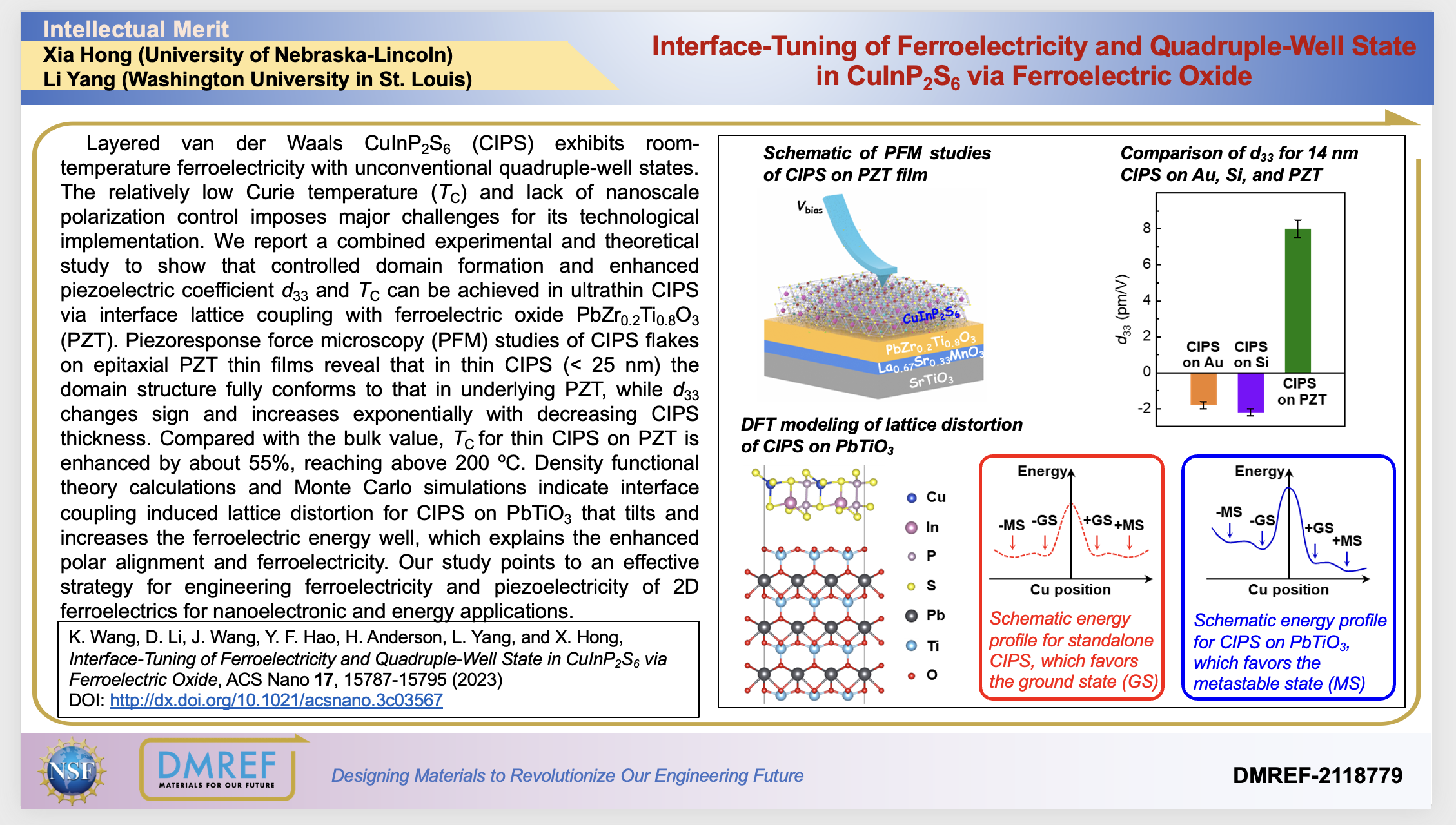
Layered van der Waals CuInP2S6 (CIPS) exhibits room-temperature ferroelectricity with unconventional quadruple-well states. The relatively low Curie temperature (TC) and lack of nanoscale polarization control imposes major challenges for its technological implementation. We report a combined experimental and theoretical study to show that controlled domain formation and enhanced piezoelectric coefficient d33 and TC can be achieved in ultrathin CIPS via interface lattice coupling with ferroelectric oxide PbZr0.2Ti0.8O3 (PZT). Piezoresponse force microscopy (PFM) studies of CIPS flakes on epitaxial PZT thin films reveal that in thin CIPS (< 25 nm) the domain structure fully conforms to that in underlying PZT, while d33 changes sign and increases exponentially with decreasing CIPS thickness. Compared with the bulk value, TC for thin CIPS on PZT is enhanced by about 55%, reaching above 200 ºC. Density functional theory calculations and Monte Carlo simulations indicate interface coupling induced lattice distortion for CIPS on PbTiO3 that tilts and increases the ferroelectric energy well, which explains the enhanced polar alignment and ferroelectricity. Our study points to an effective strategy for engineering ferroelectricity and piezoelectricity of 2D ferroelectrics for nanoelectronic and energy applications.