Structural Constraint Integration in a Generative Model for the Discovery of Quantum Materials
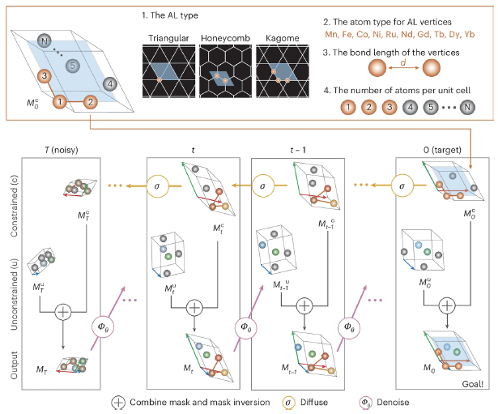
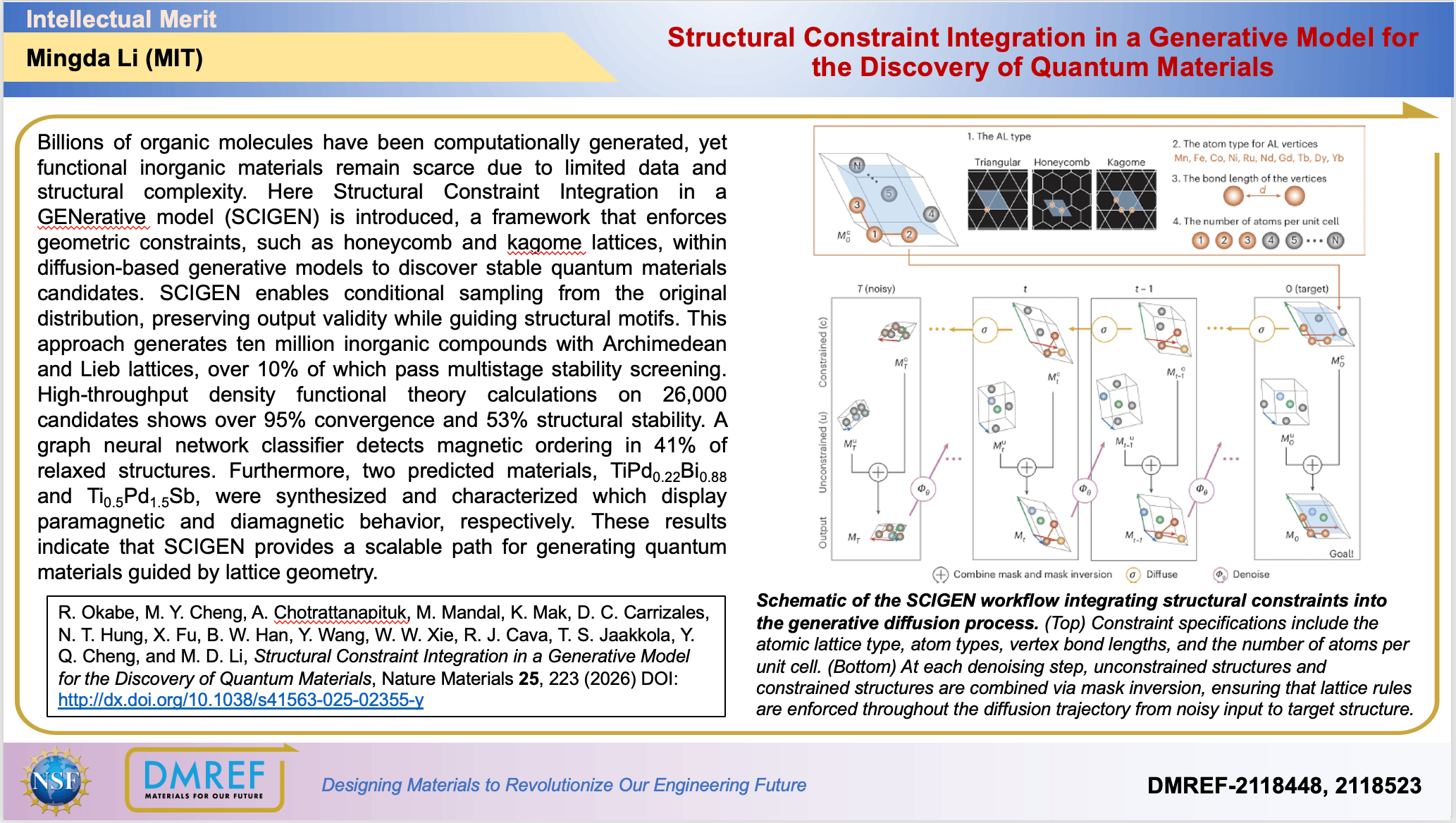
Billions of organic molecules have been computationally generated, yet functional inorganic materials remain scarce due to limited data and structural complexity. Here Structural Constraint Integration in a GENerative model (SCIGEN) is introduced, a framework that enforces geometric constraints, such as honeycomb and kagome lattices, within diffusion-based generative models to discover stable quantum materials candidates. SCIGEN enables conditional sampling from the original distribution, preserving output validity while guiding structural motifs. This approach generates ten million inorganic compounds with Archimedean and Lieb lattices, over 10% of which pass multistage stability screening. High-throughput density functional theory calculations on 26,000 candidates shows over 95% convergence and 53% structural stability. A graph neural network classifier detects magnetic ordering in 41% of relaxed structures. Furthermore, two predicted materials, TiPd0.22Bi0.88 and Ti0.5Pd1.5Sb, were synthesized and characterized which display paramagnetic and diamagnetic behavior, respectively. These results indicate that SCIGEN provides a scalable path for generating quantum materials guided by lattice geometry.