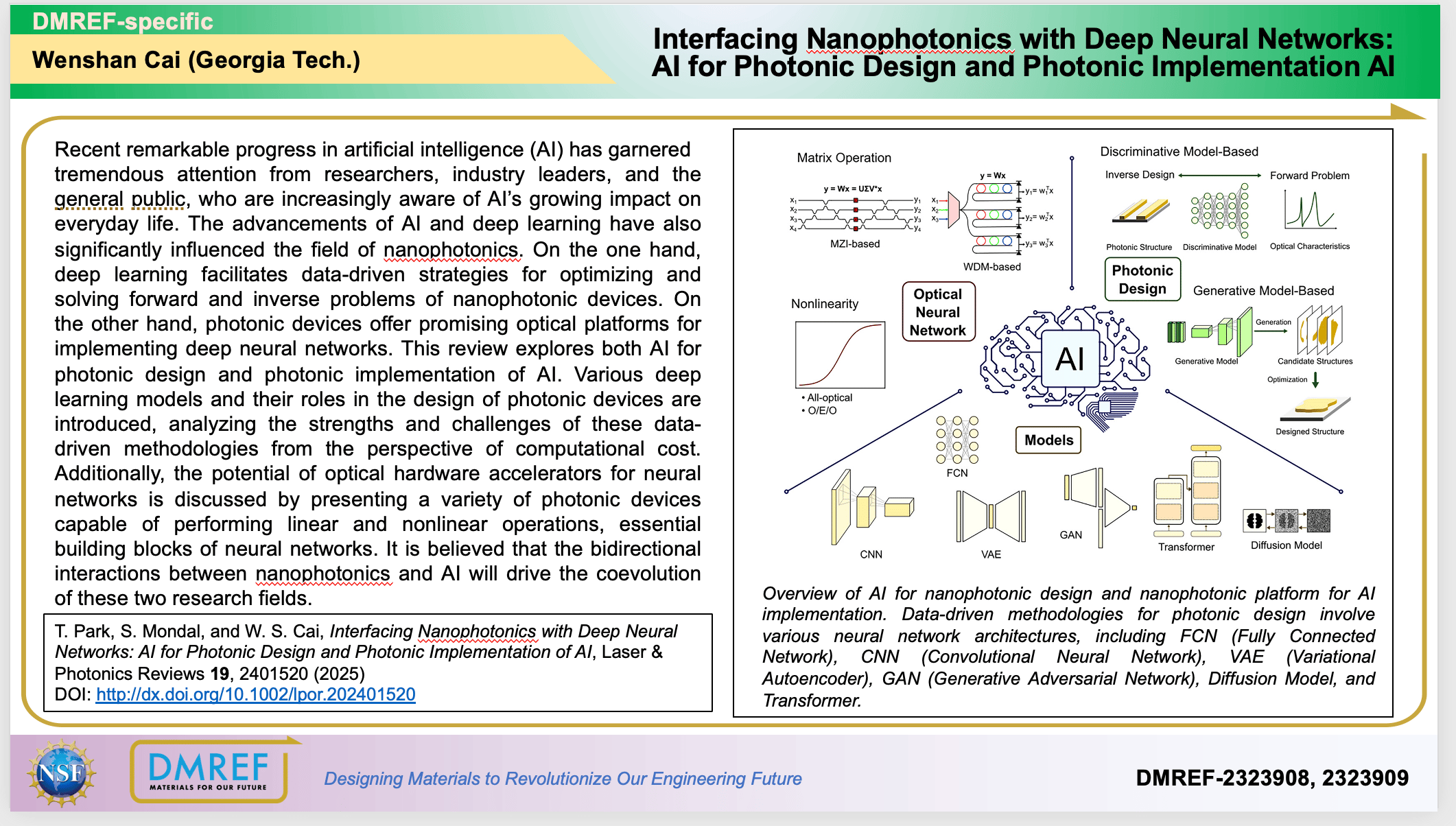
Interfacing Nanophotonics with Deep Neural Networks: AI for Photonic Design and Photonic Implementation AI
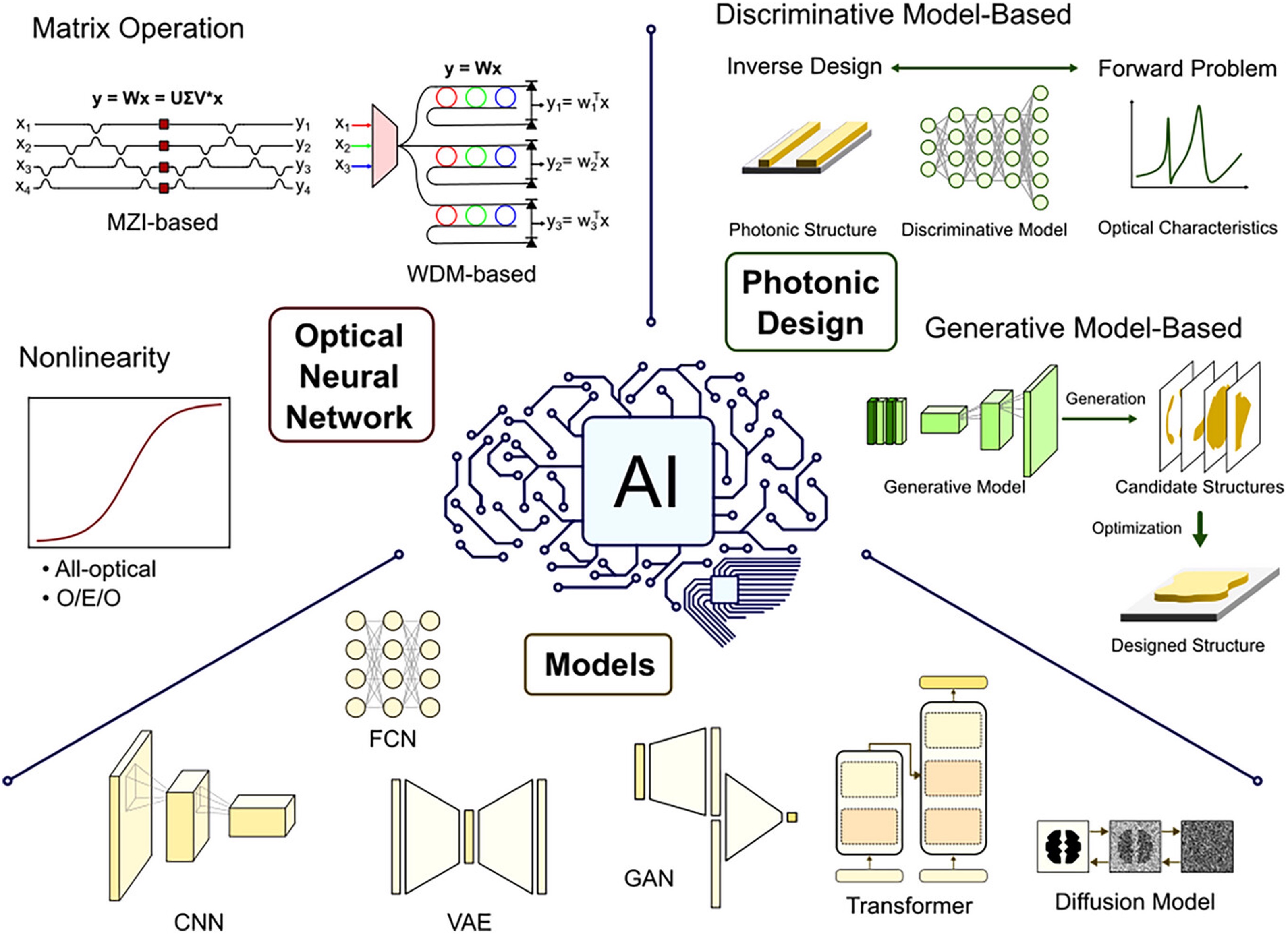
Recent remarkable progress in artificial intelligence (AI) has garnered tremendous attention from researchers, industry leaders, and the general public, who are increasingly aware of AI’s growing impact on everyday life. The advancements of AI and deep learning have also significantly influenced the field of nanophotonics. On the one hand, deep learning facilitates data-driven strategies for optimizing and solving forward and inverse problems of nanophotonic devices. On the other hand, photonic devices offer promising optical platforms for implementing deep neural networks. This review explores both AI for photonic design and photonic implementation of AI. Various deep learning models and their roles in the design of photonic devices are introduced, analyzing the strengths and challenges of these data-driven methodologies from the perspective of computational cost. Additionally, the potential of optical hardware accelerators for neural networks is discussed by presenting a variety of photonic devices capable of performing linear and nonlinear operations, essential building blocks of neural networks. It is believed that the bidirectional interactions between nanophotonics and AI will drive the coevolution of these two research fields.