Impact of Molecular Weight on Transport in Conjugated Polyelectrolytes Relevant to Organic Electrochemical Transistors
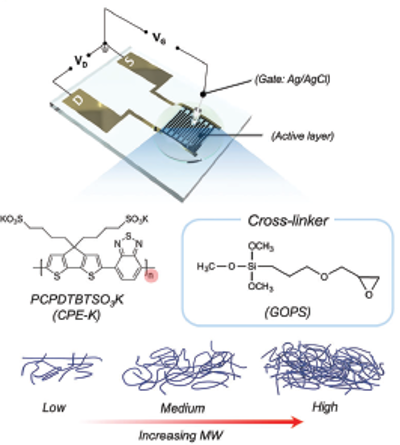
Organic electrochemical transistors (OECTs) have gained considerable attention due to their potential applications in emerging biosensor platforms. The use of conjugated polyelectrolytes (CPEs) as active materials in OECTs is particularly advantageous owing to their functional, water-processable, and biocompatible nature, as well as their tunable electronic and ionic transport properties. However, there exists a lack of systematic studies of the structure-property relationships of these materials with respect to OECT performance. This study shows how by tuning the molecular weight of self-doped CPE (CPE-K) it is possible to fabricate OECTs with a remarkable figure of merit value, one order of magnitude higher than previously reported for CPE-based devices. Furthermore, OECTs with a transconductance of 120 mS were demonstrated via device engineering. While CPE-K batches with different molecular weights show good doping behavior and high volumetric capacitance, the medium molecular weight possesses the highest carrier mobility leading to the highest transconductance. The enhanced charge transport is due to a favorable charge percolation pathway. These insights provide guidelines for further improving the performance of CPE-based OECTs.