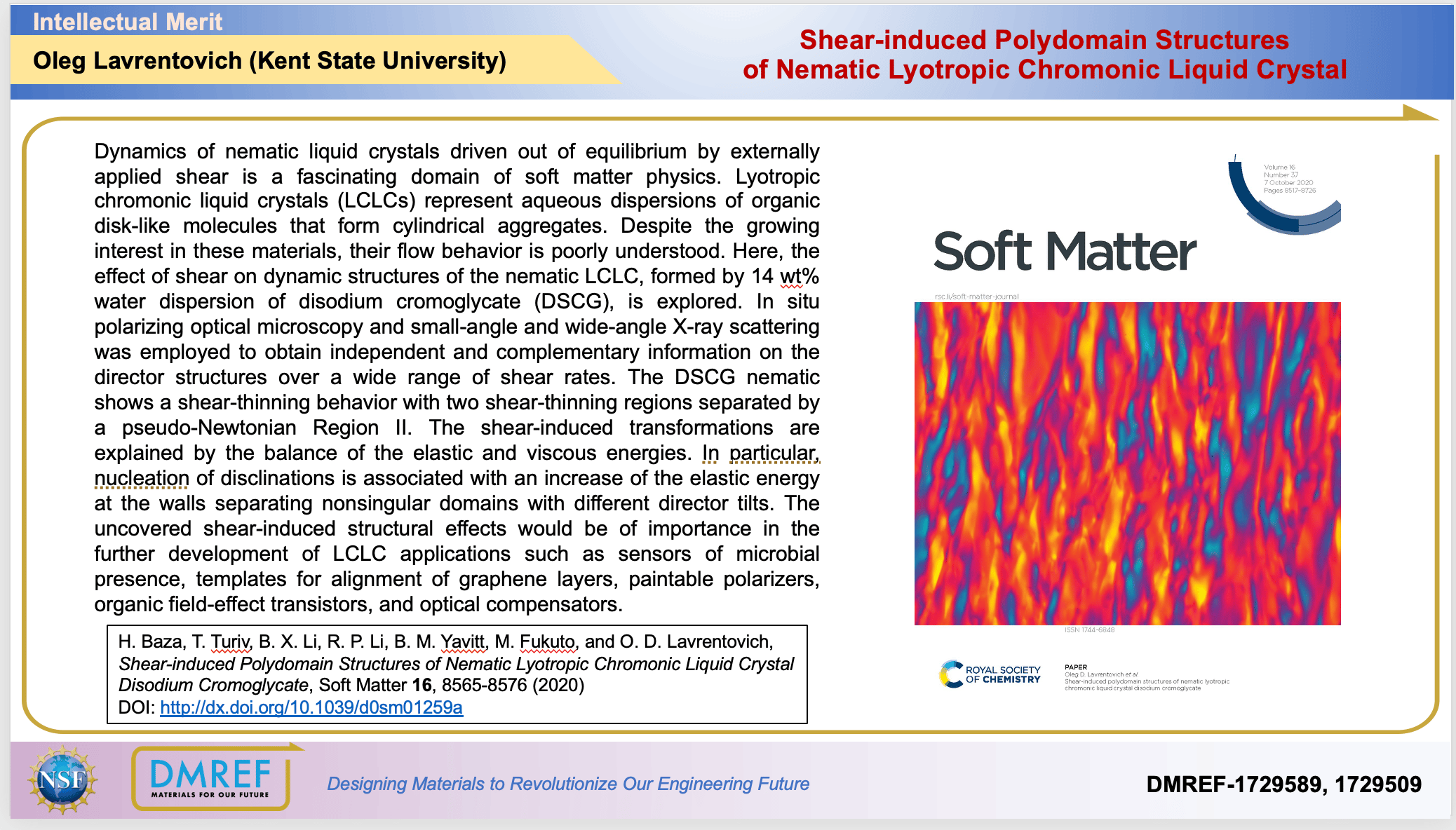
Shear-induced Polydomain Structures of Nematic Lyotropic Chromonic Liquid Crystal
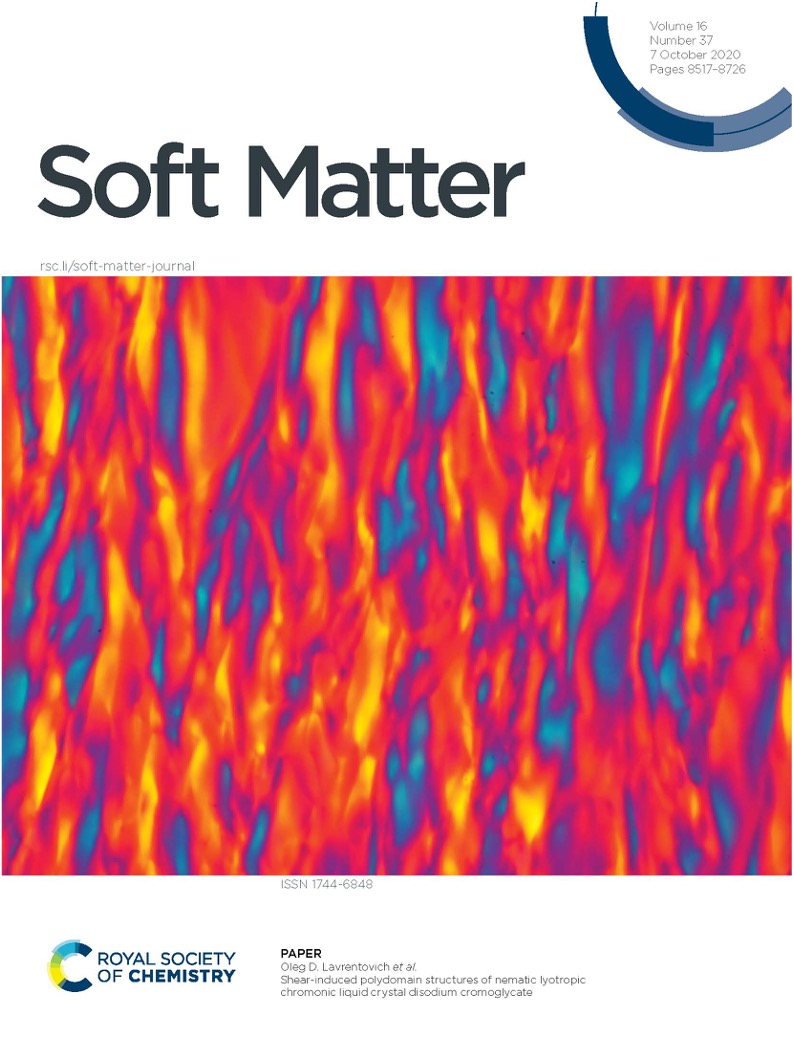
Dynamics of nematic liquid crystals driven out of equilibrium by externally applied shear is a fascinating domain of soft matter physics. Lyotropic chromonic liquid crystals (LCLCs) represent aqueous dispersions of organic disk-like molecules that form cylindrical aggregates. Despite the growing interest in these materials, their flow behavior is poorly understood. Here, the effect of shear on dynamic structures of the nematic LCLC, formed by 14 wt% water dispersion of disodium cromoglycate (DSCG), is explored. In situ polarizing optical microscopy and small-angle and wide-angle X-ray scattering was employed to obtain independent and complementary information on the director structures over a wide range of shear rates. The DSCG nematic shows a shear-thinning behavior with two shear-thinning regions separated by a pseudo-Newtonian Region II. The shear-induced transformations are explained by the balance of the elastic and viscous energies. In particular, nucleationof disclinations is associated with an increase of the elastic energy at the walls separating nonsingular domains with different director tilts. The uncovered shear-induced structural effects would be of importance in the further development of LCLC applications such as sensors of microbial presence, templates for alignment of graphene layers, paintable polarizers, organic field-effect transistors, and optical compensators.