Toroidal Nuclei of Columnar Lyotropic Chromonic Liquid Crystals Coexisting with an Isotropic Phase
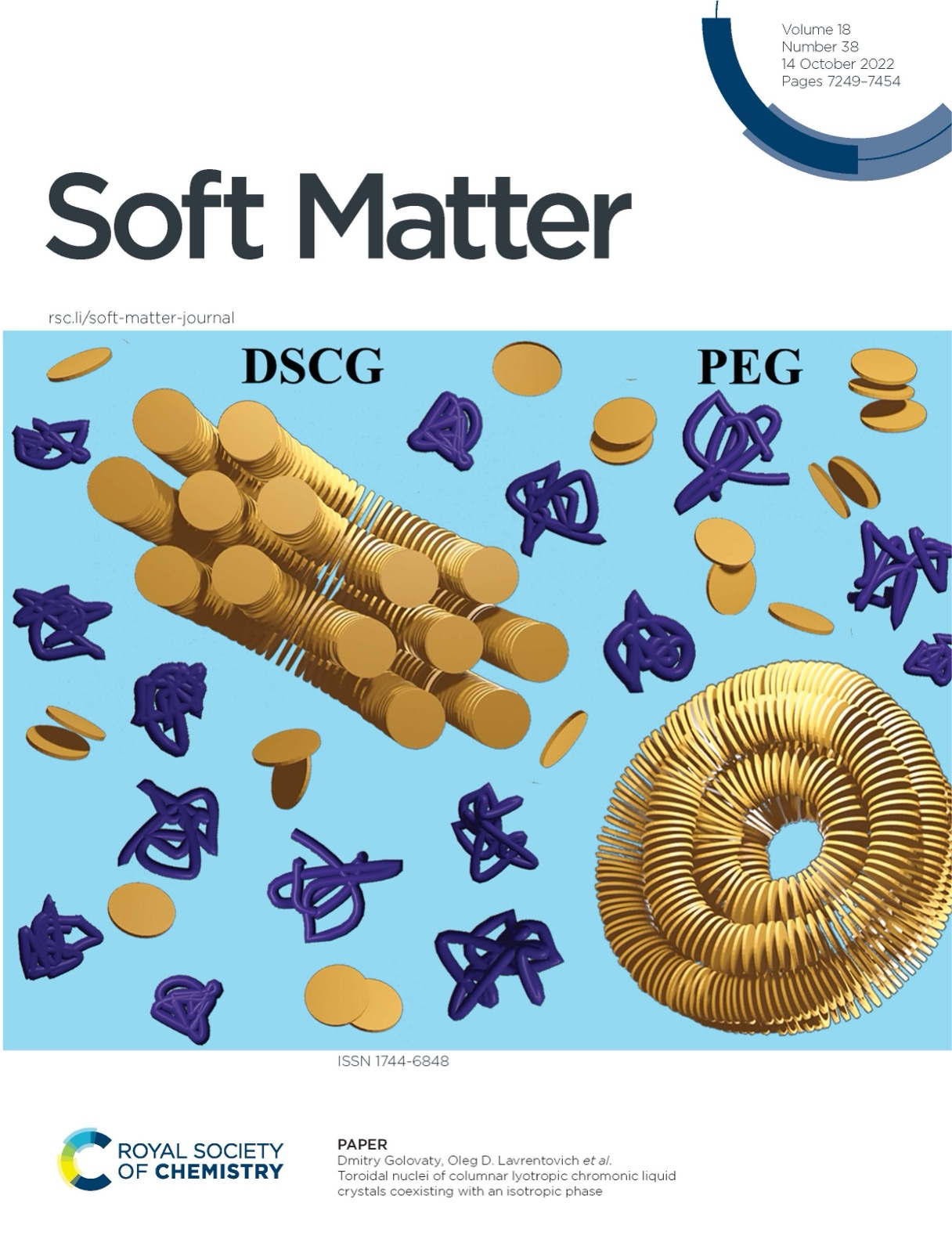
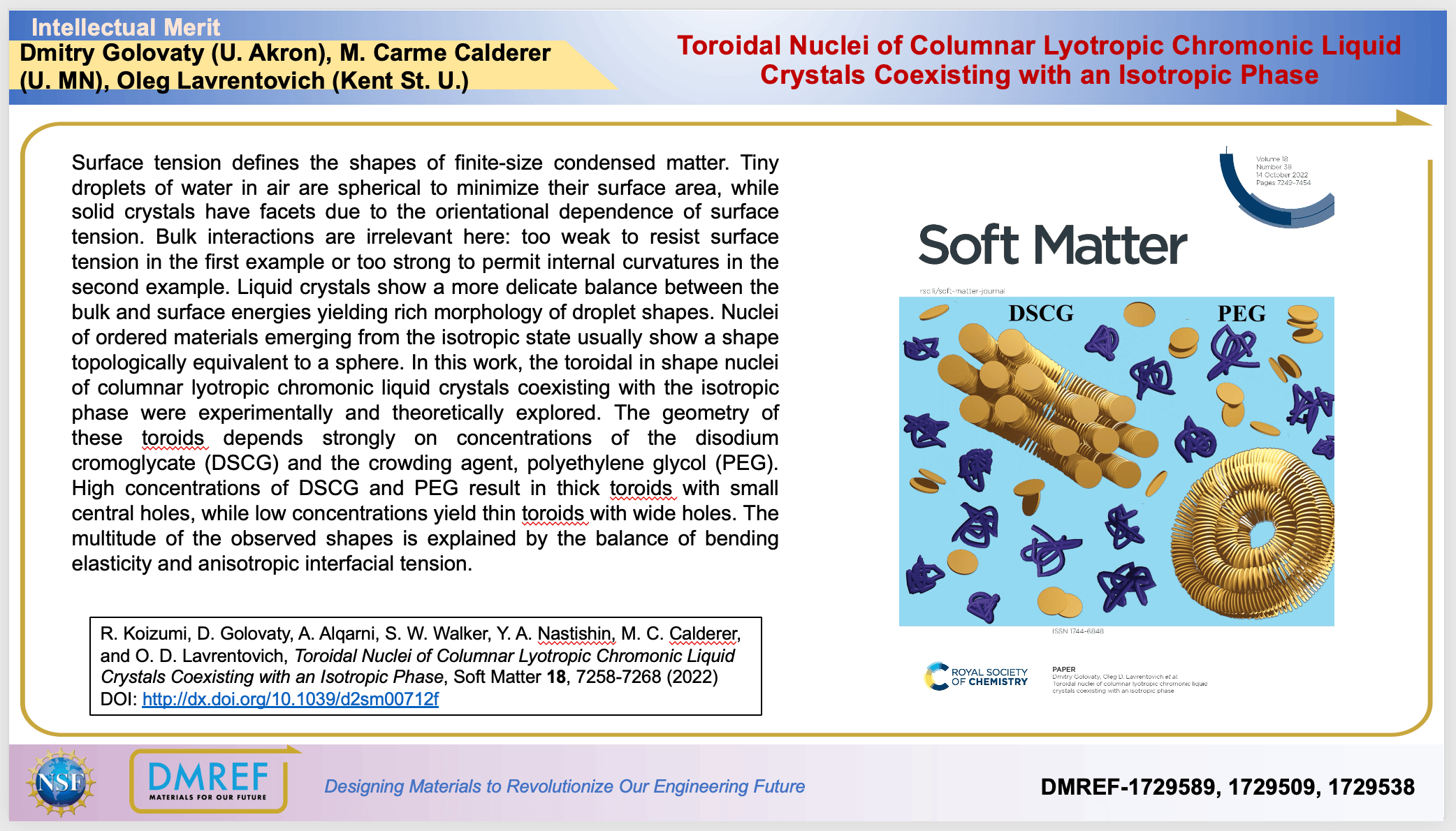
Surface tension defines the shapes of finite-size condensed matter. Tiny droplets of water in air are spherical to minimize their surface area, while solid crystals have facets due to the orientational dependence of surface tension. Bulk interactions are irrelevant here: too weak to resist surface tension in the first example or too strong to permit internal curvatures in the second example. Liquid crystals show a more delicate balance between the bulk and surface energies yielding rich morphology of droplet shapes. Nuclei of ordered materials emerging from the isotropic state usually show a shape topologically equivalent to a sphere. In this work, the toroidal in shape nuclei of columnar lyotropic chromonic liquid crystals coexisting with the isotropic phase were experimentally and theoretically explored. The geometry of these toroids depends strongly on concentrations of the disodium cromoglycate (DSCG) and the crowding agent, polyethylene glycol (PEG). High concentrations of DSCG and PEG result in thick toroids with small central holes, while low concentrations yield thin toroids with wide holes. The multitude of the observed shapes is explained by the balance of bending elasticity and anisotropic interfacial tension.