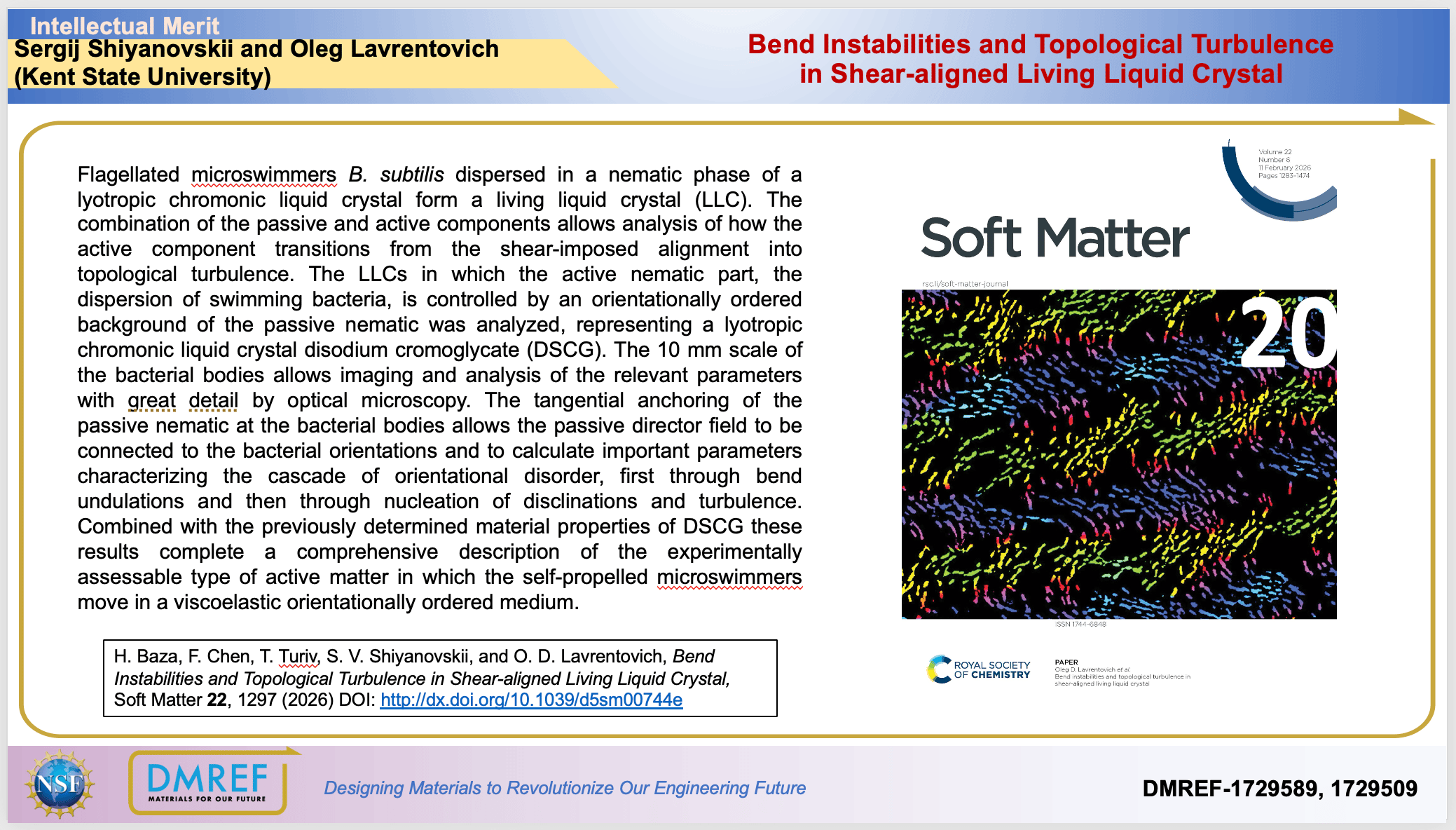
Bend Instabilities and Topological Turbulence in Shear-aligned Living Liquid Crystal

Flagellated microswimmers B. subtilis dispersed in a nematic phase of a lyotropic chromonic liquid crystal form a living liquid crystal (LLC). The combination of the passive and active components allows analysis of how the active component transitions from the shear-imposed alignment into topological turbulence. The LLCs in which the active nematic part, the dispersion of swimming bacteria, is controlled by an orientationally ordered background of the passive nematic was analyzed, representing a lyotropic chromonic liquid crystal disodium cromoglycate (DSCG). The 10 mm scale of the bacterial bodies allows imaging and analysis of the relevant parameters with great detail by optical microscopy. The tangential anchoring of the passive nematic at the bacterial bodies allows the passive director field to be connected to the bacterial orientations and to calculate important parameters characterizing the cascade of orientational disorder, first through bend undulations and then through nucleation of disclinations and turbulence. Combined with the previously determined material properties of DSCG these results complete a comprehensive description of the experimentally assessable type of active matter in which the self-propelled microswimmers move in a viscoelastic orientationally ordered medium.