Opto-twistronic Hall Effect in a Three-dimensional Spiral Lattice
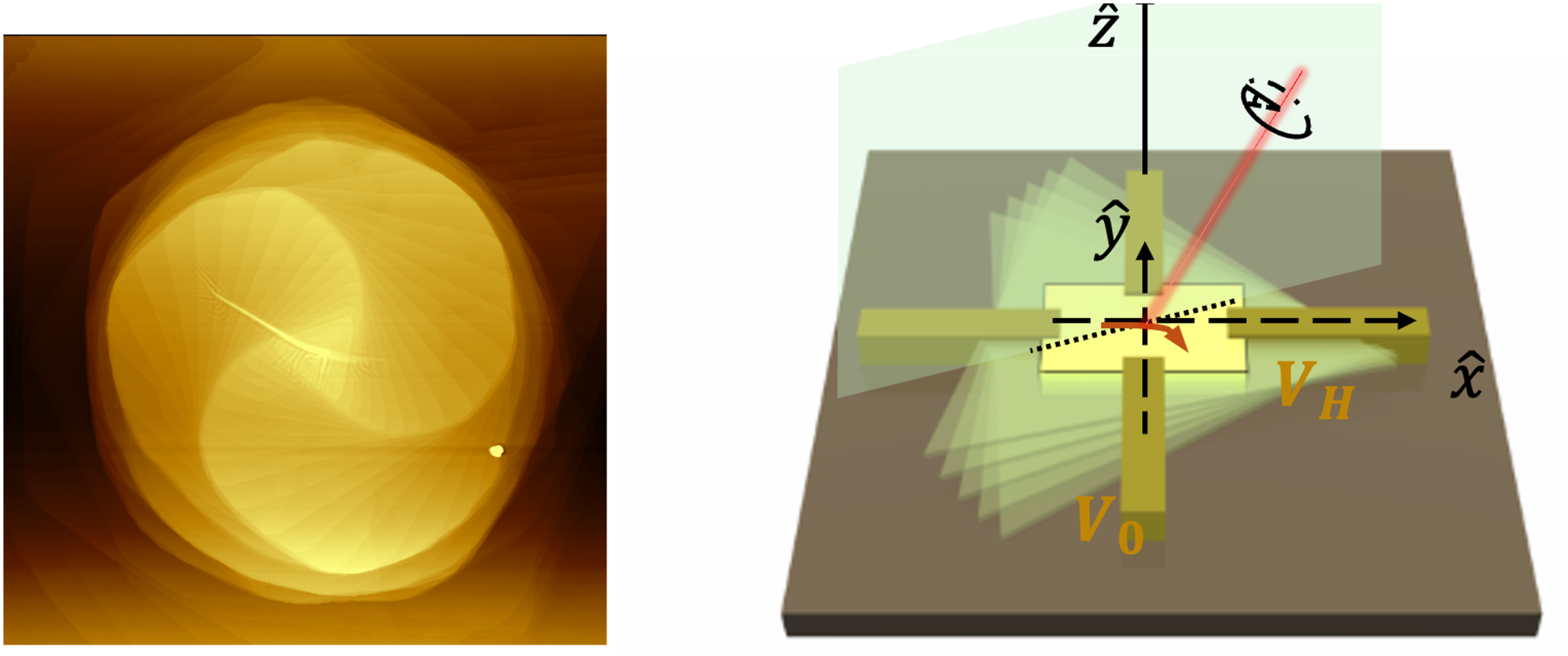
Studies of moire systems have explained the effect of superlattice modulations on their properties, demonstrating new correlated phases. However, most experimental studies have focused on a few layers in 2D systems. Extending twistronics to three dimensions, in which the twist extends into the third dimension, remains underexplored because of the challenges associated with the manual stacking of layers. In this work, three-dimensional twistronics are studied using a self-assembled twisted spiral superlattice of multilayered WS2. Here, an opto-twistronic Hall effect was identified, driven by structural chirality and coherence length, and modulated by the moire potential of the spiral superlattice. This supertwisted system bridges 2D and 3D twistronics, overcoming length scale differences between electrons and photons to enhance optical nonlinearities beyond simple optical selection rules and pushes the boundaries of light-induced quantum phenomena. The model suggests contributions from higher-order quantum geometric quantities to this observation, providing opportunities for designing quantum-materials-based optoelectronic lattices with large nonlinearities.
