Machine-guided Discovery of Acrylate Photopolymer Compositions

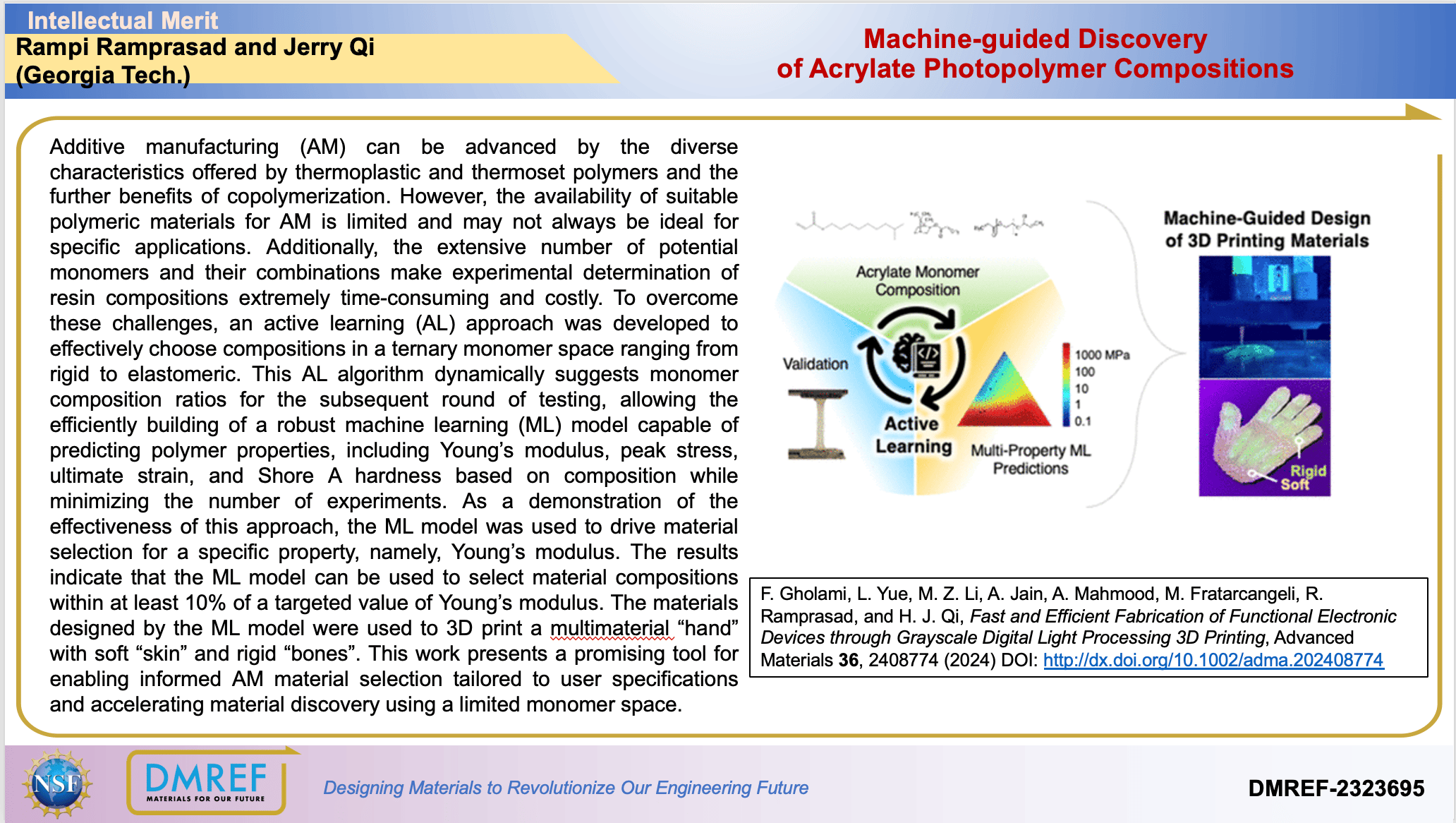
Additive manufacturing (AM) can be advanced by the diverse characteristics offered by thermoplastic and thermoset polymers and the further benefits of copolymerization. However, the availability of suitable polymeric materials for AM is limited and may not always be ideal for specific applications. Additionally, the extensive number of potential monomers and their combinations make experimental determination of resin compositions extremely time-consuming and costly. To overcome these challenges, an active learning (AL) approach was developed to effectively choose compositions in a ternary monomer space ranging from rigid to elastomeric. This AL algorithm dynamically suggests monomer composition ratios for the subsequent round of testing, allowing the efficiently building of a robust machine learning (ML) model capable of predicting polymer properties, including Young’s modulus, peak stress, ultimate strain, and Shore A hardness based on composition while minimizing the number of experiments. As a demonstration of the effectiveness of this approach, the ML model was used to drive material selection for a specific property, namely, Young’s modulus. The results indicate that the ML model can be used to select material compositions within at least 10% of a targeted value of Young’s modulus. The materials designed by the ML model were used to 3D print a multimaterial“hand” with soft “skin” and rigid “bones”. This work presents a promising tool for enabling informed AM material selection tailored to user specifications and accelerating material discovery using a limited monomer space.