
Developing a Complete AI-accelerated Workflow for Superconductor Discovery
Sep 28, 2026
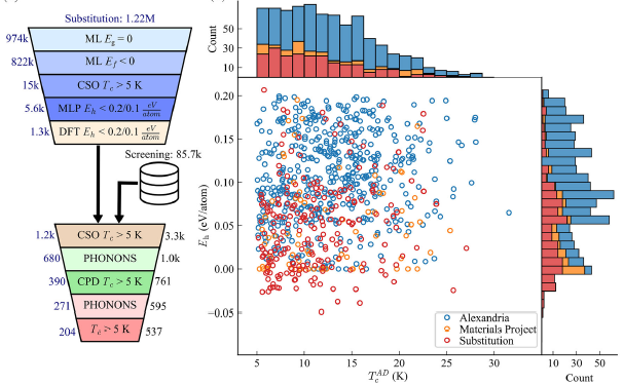
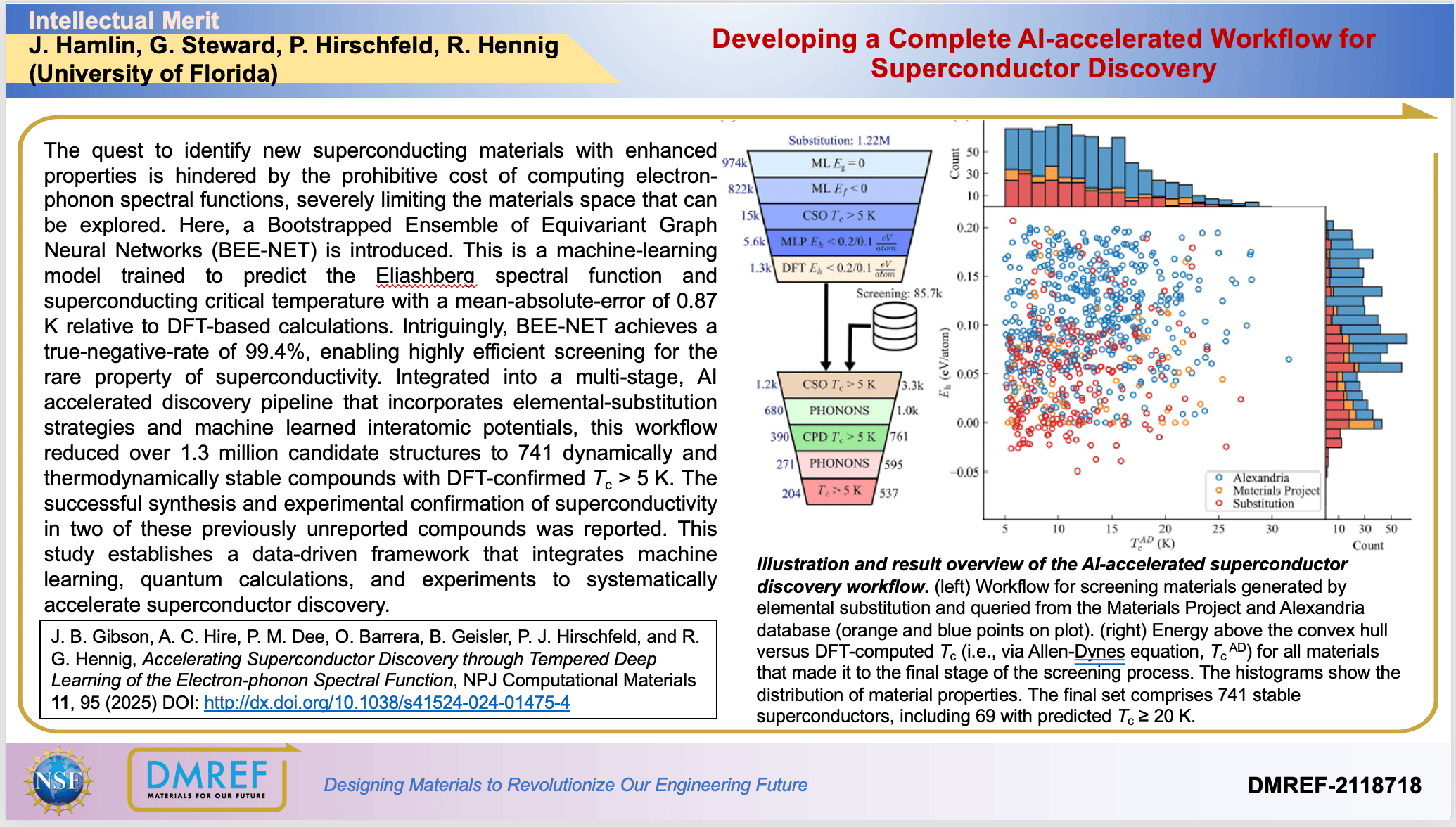
Illustration and result overview of the AI-accelerated superconductor discovery workflow. (left) Workflow for screening materials generated by elemental substitution and queried from the Materials Project and Alexandria database (orange and blue points on plot). (right) Energy above the convex hull versus DFT-computed Tc (i.e., via Allen-Dynes equation, Tc AD) for all materials that made it to the final stage of the screening process. The histograms show the distribution of material properties. The final set comprises 741 stable superconductors, including 69 with predicted Tc ≥ 20 K.

The quest to identify new superconducting materials with enhanced properties is hindered by the prohibitive cost of computing electron-phonon spectral functions, severely limiting the materials space that can be explored. Here, a Bootstrapped Ensemble of Equivariant Graph Neural Networks (BEE-NET) is introduced. This is a machine-learning model trained to predict the Eliashberg spectral function and superconducting critical temperature with a mean-absolute-error of 0.87 K relative to DFT-based calculations. Intriguingly, BEE-NET achieves a true-negative-rate of 99.4%, enabling highly efficient screening for the rare property of superconductivity. Integrated into a multi-stage, AI accelerated discovery pipeline that incorporates elemental-substitution strategies and machine learned interatomic potentials, this workflow reduced over 1.3 million candidate structures to 741 dynamically and thermodynamically stable compounds with DFT-confirmed Tc > 5 K. The successful synthesis and experimental confirmation of superconductivity in two of these previously unreported compounds was reported. This study establishes a data-driven framework that integrates machine learning, quantum calculations, and experiments to systematically accelerate superconductor discovery.
Authors

J. Hamlin, G. Steward, P. Hirschfeld, R. Hennig (University of Florida)

Additional Materials

U.S. National Science Foundation and NSF DMREF, Materials for Our Future

This material is based upon work supported by the U.S. National Science Foundation Award No. 2015237. Any opinions, findings, and conclusions or recommendations expressed in this material are those of the author(s) and do not necessarily reflect the views of the U.S. National Science Foundation. This site is maintained collaboratively by principal investigators with NSF DMREF awards, independent of the NSF.