The 2025 NSF DMREF cohort includes 25 new projects that show the breadth of modern materials design — from clean manufacturing and energy storage to quantum technologies, microchips, catalysts, and bioelectronics. Together, the awards represent a $50 million NSF investment involving 104 researchers at 44 universities across 25 states, with federal laboratory and international partnerships.
Several projects focus on using AI to accelerate discovery. At the University of Florida, Richard Hennig leads AISuper, a project combining artificial intelligence, quantum theory, and experimental synthesis to search for new superconducting materials for magnets. The team is looking for materials with practical properties such as high critical temperatures and magnetic fields, ductility for wire fabrication, and strong performance in three-dimensional electronic structures — important for technologies ranging from MRI systems to quantum computing and sustainable energy.
At Rice University, Kai Gong leads a project to rethink cement production using flash Joule heating, an electrified process that heats raw materials in seconds. The goal is to make cement clinker production faster and more modular while reducing production costs, energy use, and environmental impact. The project matters because cement is essential to infrastructure but remains one of the most energy- and resource-intensive materials to manufacture.
“Flash Joule heating gives us an electricity-driven way to reach the high temperatures needed for cement chemistry in seconds, rather than relying solely on conventional long-duration kiln processing,” says Gong. “That opens a path toward faster, more modular, and more controllable manufacturing, while also giving us the opportunity to explore a broader range of mineral feedstocks for more resource-efficient cement production.”
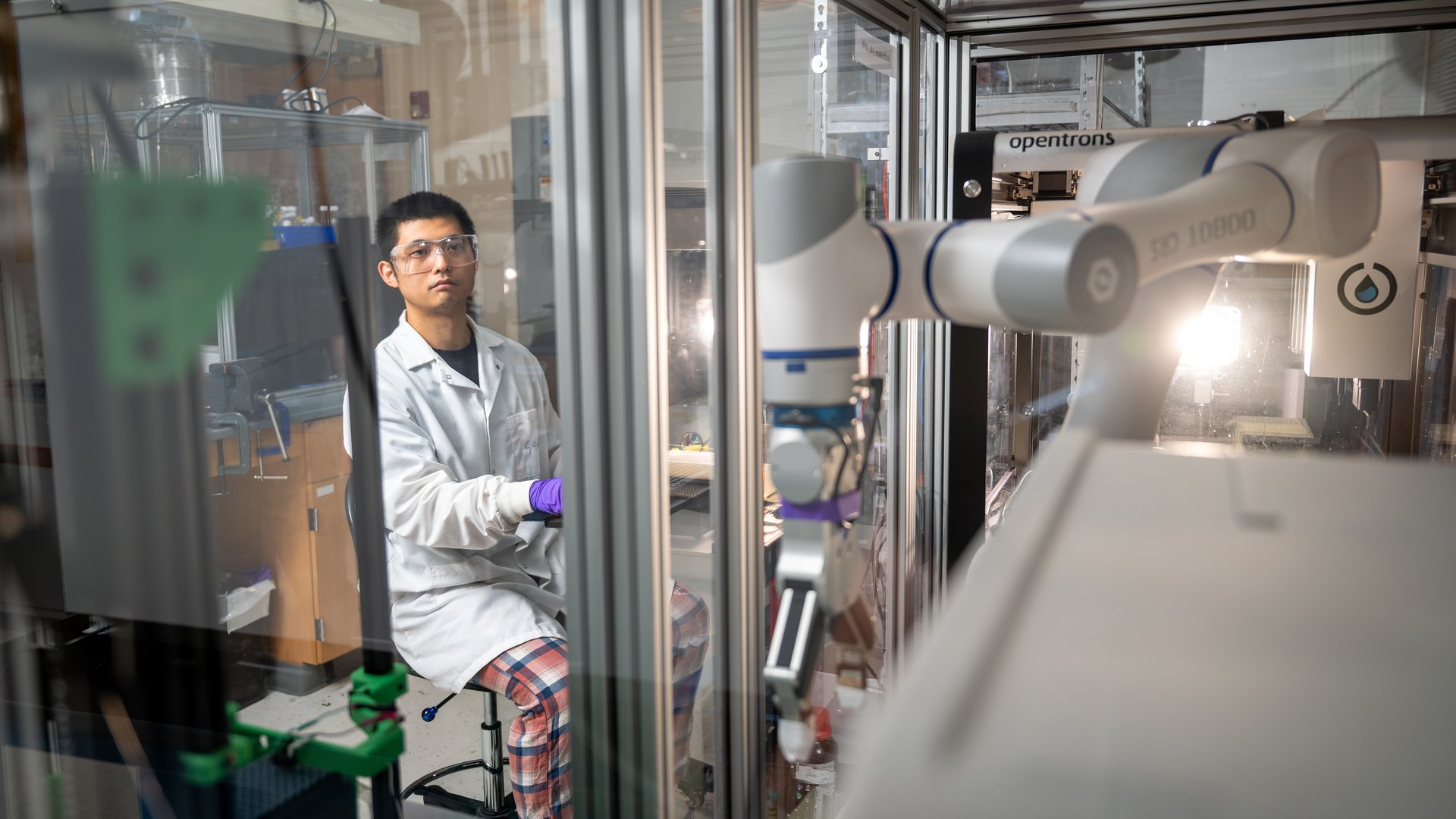
Other teams are targeting energy and electronics. Christopher Evans at the University of Illinois Urbana-Champaign is leading an AI-guided effort to design sustainable peptide electrolytes for safer, thermally stable energy storage materials. At North Carolina State, Milad Abolhasani is leading a project that will use distributed self-driving laboratories to discover high-performance, lead-free perovskite nanocrystals for electronics and quantum technologies.
“The future of materials science will depend on our ability to integrate human creativity, artificial intelligence, and autonomous experimentation into closed-loop discovery networks,” says Abolhasani. “This approach allows us to explore complex materials spaces faster, learn from every experiment, and move promising discoveries toward real-world technologies with greater speed and confidence.”