Theory-guided Targeted Delivery of Nanoparticles in Advective Environmental Porous Media
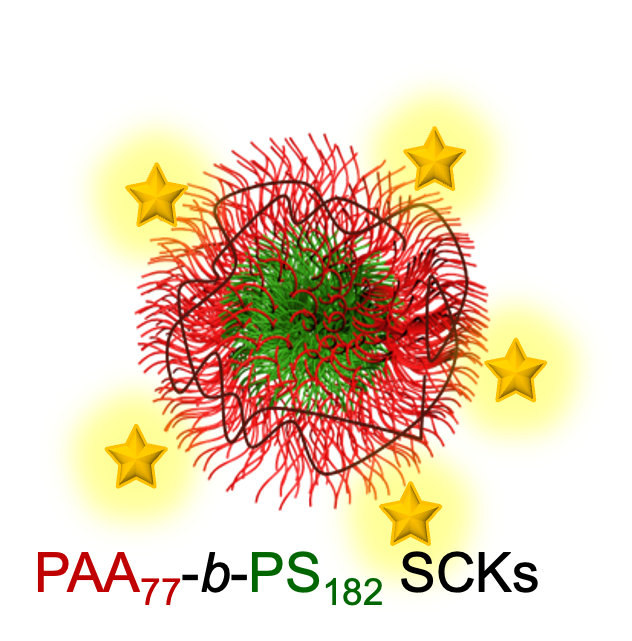
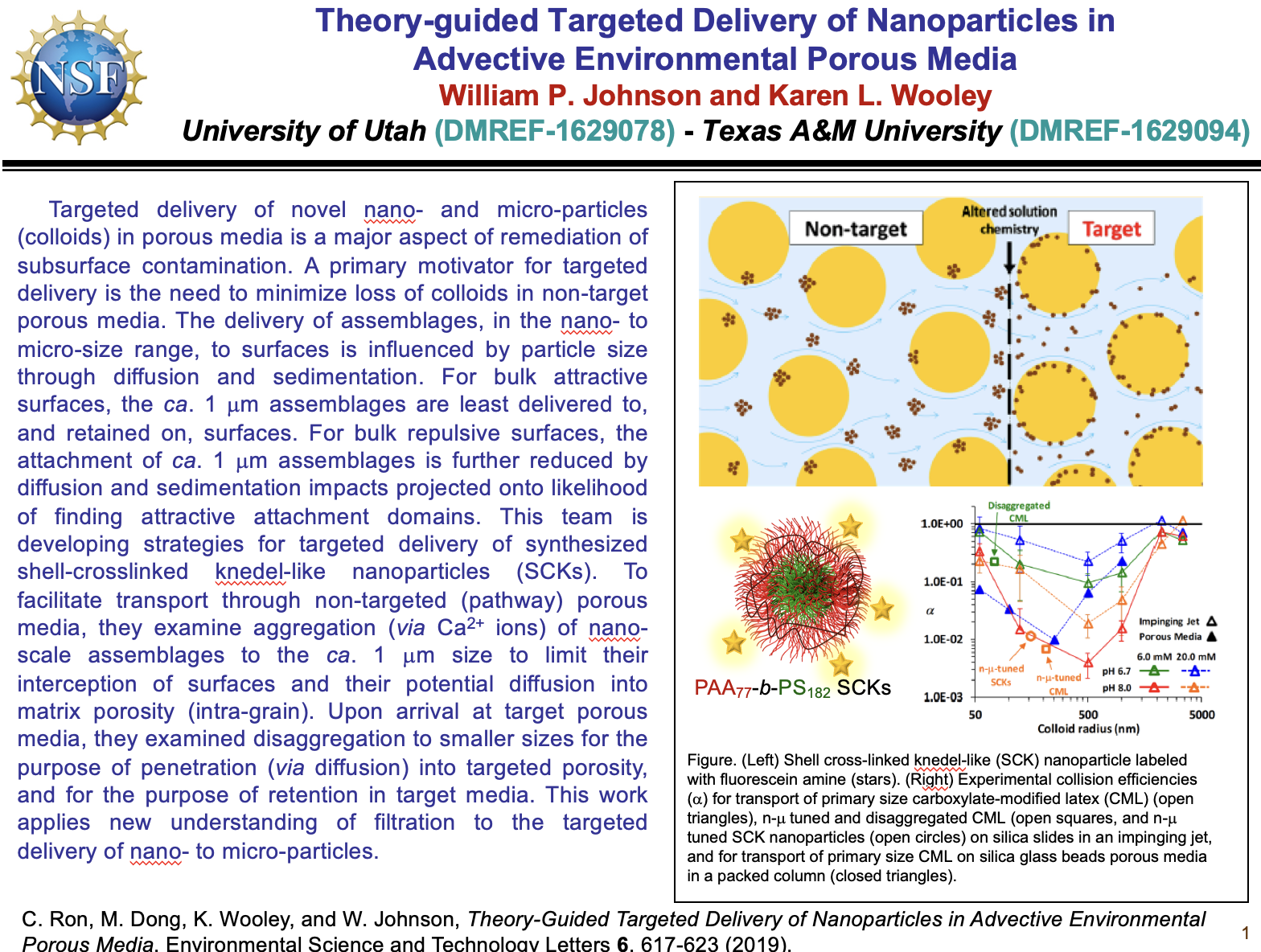
Targeted delivery of novel nano- and micro-particles (colloids) in porous media is a major aspect of remediation of subsurface contamination. A primary motivator for targeted delivery is the need to minimize loss of colloids in non-target porous media. The delivery of assemblages, in the nano- to micro-size range, to surfaces is influenced by particle size through diffusion and sedimentation. For bulk attractive surfaces, the ca. 1 mm assemblages are least delivered to, and retained on, surfaces. For bulk repulsive surfaces, the attachment of ca. 1 mm assemblages is further reduced by diffusion and sedimentation impacts projected onto likelihood of finding attractive attachment domains. This team is developing strategies for targeted delivery of synthesized shell-crosslinked knedel-like nanoparticles (SCKs). To facilitate transport through non-targeted (pathway) porous media, they examine aggregation (via Ca2+ ions) of nano-scale assemblages to the ca. 1 mm size to limit their interception of surfaces and their potential diffusion into matrix porosity (intra-grain). Upon arrival at target porous media, they examined disaggregation to smaller sizes for the purpose of penetration (via diffusion) into targeted porosity, and for the purpose of retention in target media. This work appliesnew understanding of filtration to the targeted delivery of nano- to micro-particles.