Ultrabright Fluorescent Organic Nanoparticles
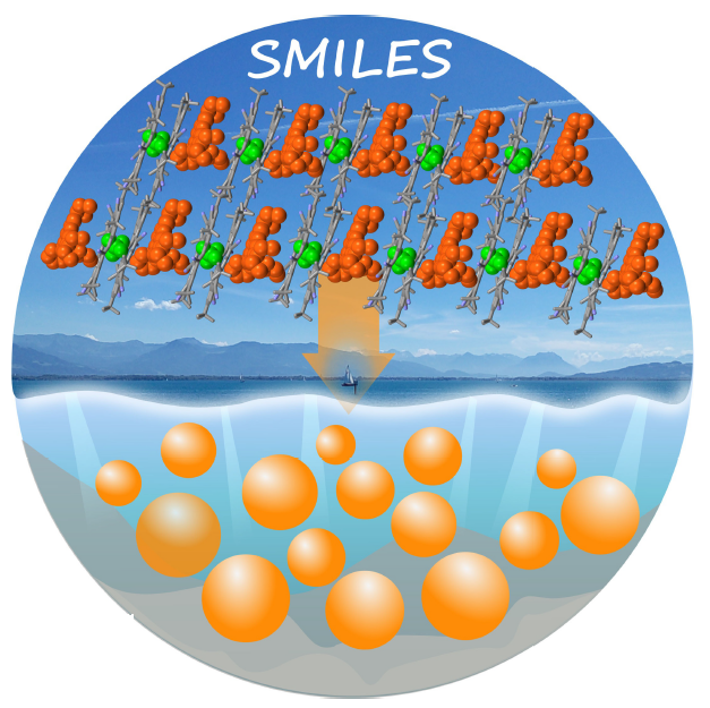
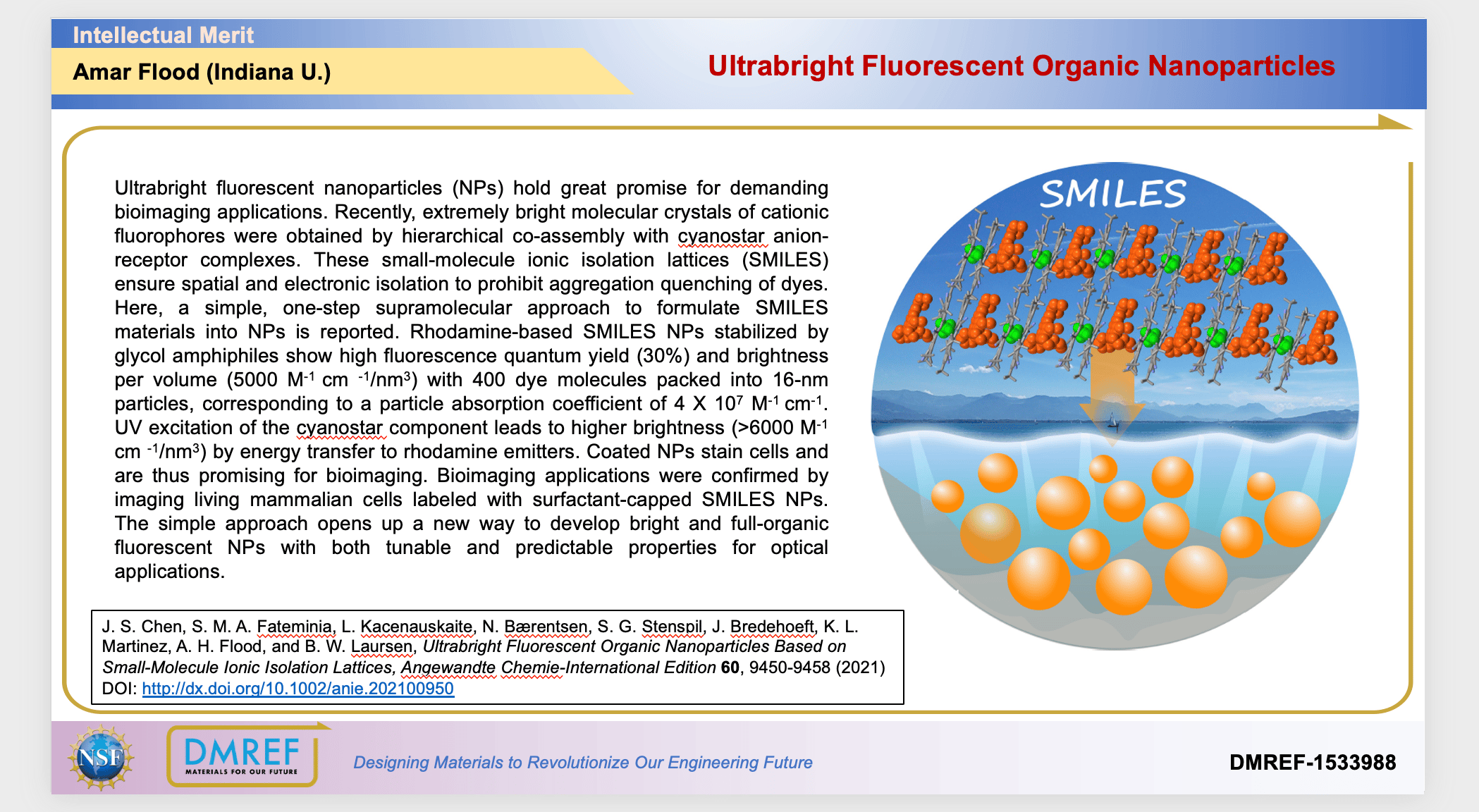
Ultrabright fluorescent nanoparticles (NPs) hold great promise for demanding bioimaging applications. Recently, extremely bright molecular crystals of cationic fluorophores were obtained by hierarchical co-assembly with cyanostar anion-receptor complexes. These small-molecule ionic isolation lattices (SMILES) ensure spatial and electronic isolation to prohibit aggregation quenching of dyes.
Here, a simple, one-step supramolecular approach to formulate SMILES materials into NPs is reported. Rhodamine-based SMILES NPs stabilized by glycol amphiphiles show high fluorescence quantum yield (30%) and brightness per volume (5000 M-1 cm -1/nm3) with 400 dye molecules packed into 16-nm particles, corresponding to a particle absorption coefficient of 4 X 10⁷ M-1 cm-1. UV excitation of the cyanostar component leads to higher brightness (>6000 M-1 cm -1/nm3) by energy transfer to rhodamine emitters. Coated NPs stain cells and are thus promising for bioimaging. Bioimaging applications were confirmed by imaging living mammalian cells labeled with surfactant-capped SMILES NPs.
The simple approach opens up a new way to develop bright and full-organic fluorescent NPs with both tunable and predictable properties for optical applications.