Ultrahard WB2 Superconducts under Pressure
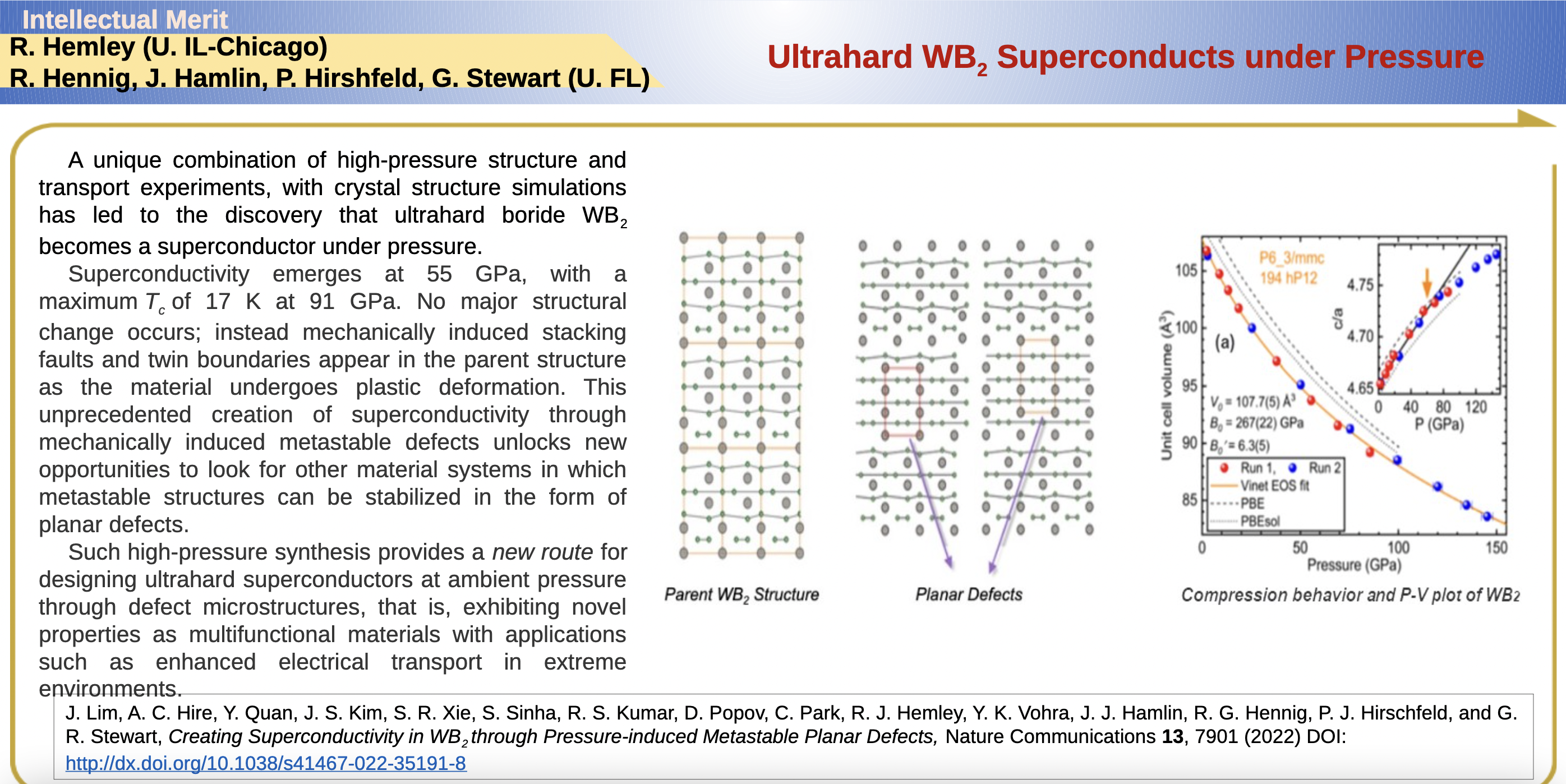
A unique combination of high-pressure structure and transport experiments, with crystal structure simulations has led to the discovery that ultrahard boride WB2 becomes a superconductor under pressure.
Superconductivity emerges at 55 GPa, with a maximum Tc of 17 K at 91 GPa. No major structural change occurs; instead mechanically induced stacking faults and twin boundaries appear in the parent structure as the material undergoes plastic deformation. This unprecedented creation of superconductivity through mechanically induced metastable defects unlocks new opportunities to look for other material systems in which metastable structures can be stabilized in the form of planar defects.
Such high-pressure synthesis provides a new route for designing ultrahard superconductors at ambient pressure through defect microstructures, that is, exhibiting novel properties as multifunctional materials with applications such as enhanced electrical transport in extreme environments.