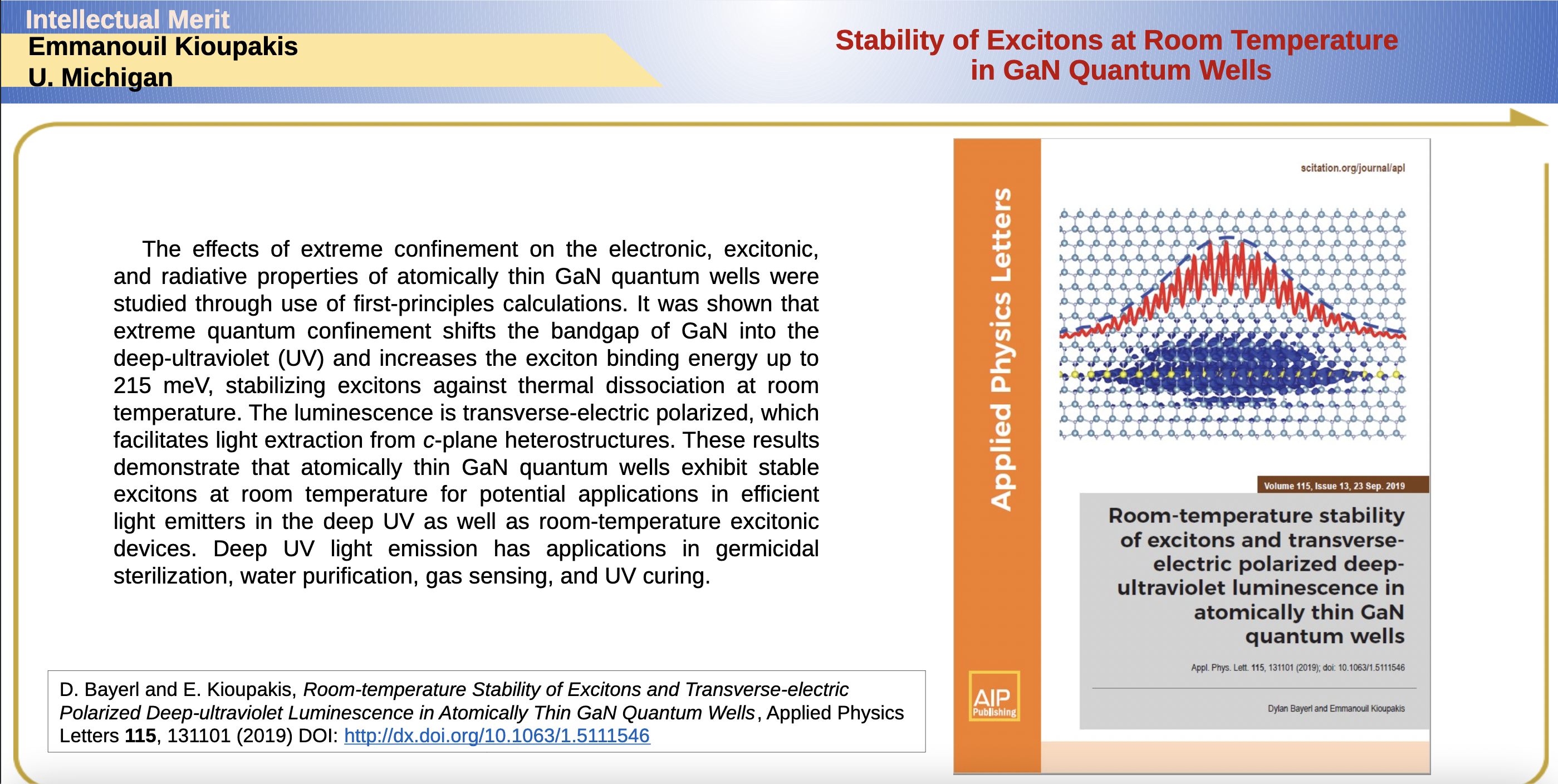
Stability of Excitons at Room Temperature in GaN Quantum Wells
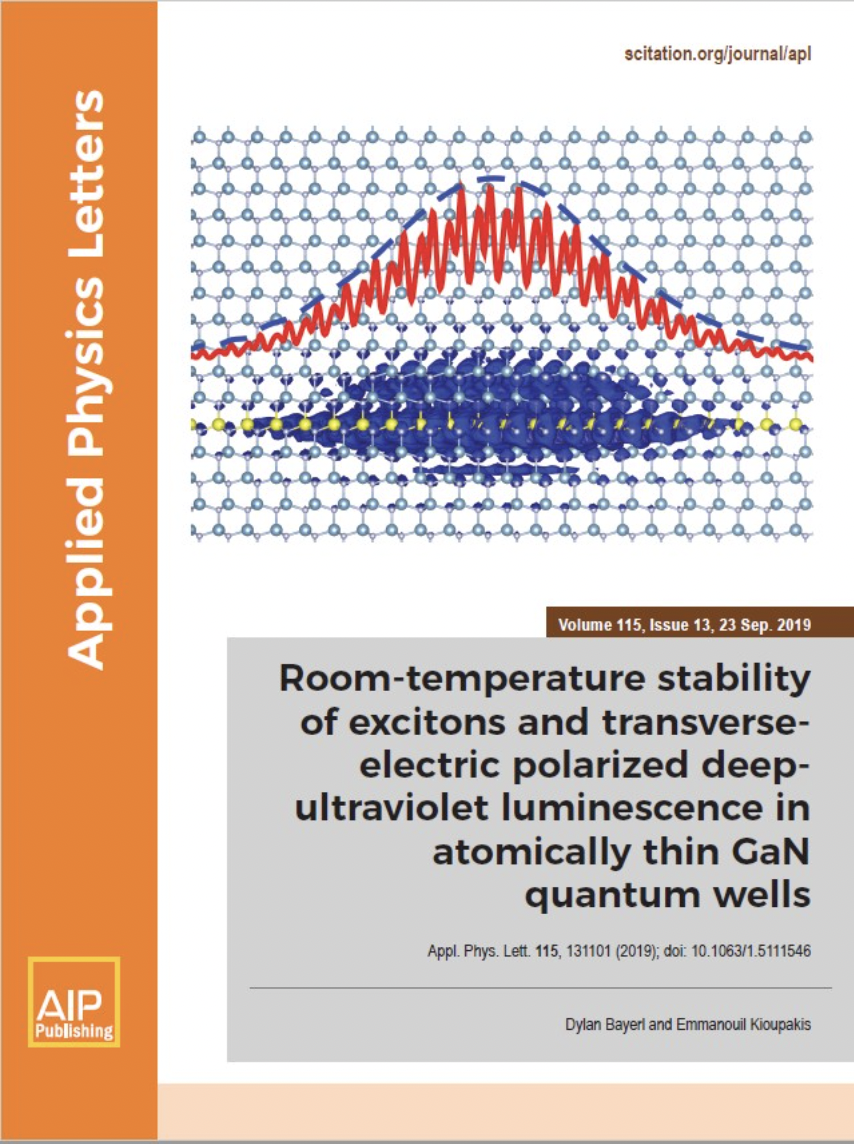
The effects of extreme confinement on the electronic, excitonic, and radiative properties of atomically thin GaN quantum wells were studied through use of first-principles calculations. It was shown that extreme quantum confinement shifts the bandgap of GaN into the deep-ultraviolet (UV) and increases the exciton binding energy up to 215 meV, stabilizing excitons against thermal dissociation at room temperature. The luminescence is transverse-electric polarized, which facilitates light extraction from c-plane heterostructures. These results demonstrate that atomically thin GaN quantum wells exhibit stable excitons at room temperature for potential applications in efficient light emitters in the deep UV as well as room-temperature excitonic devices. Deep UV light emission has applications in germicidal sterilization, water purification, gas sensing, and UV curing.