
Polymer Foams for Oil Recovery

Nov 3, 2022
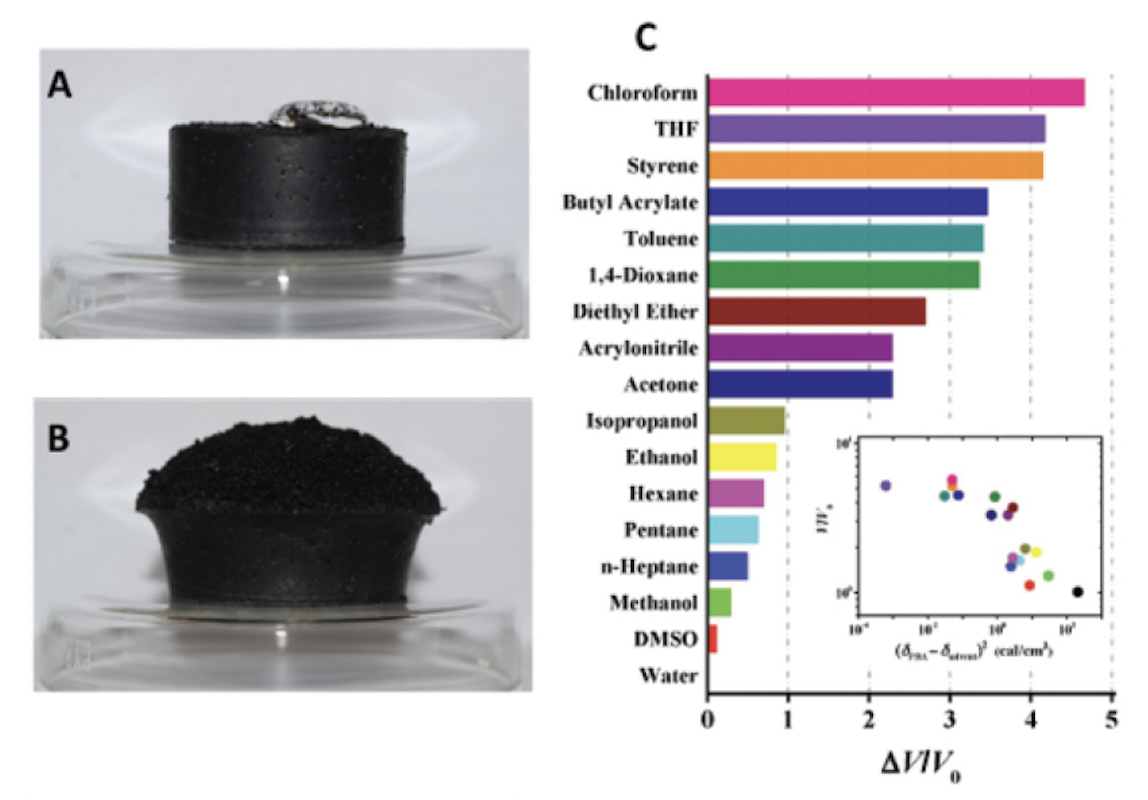
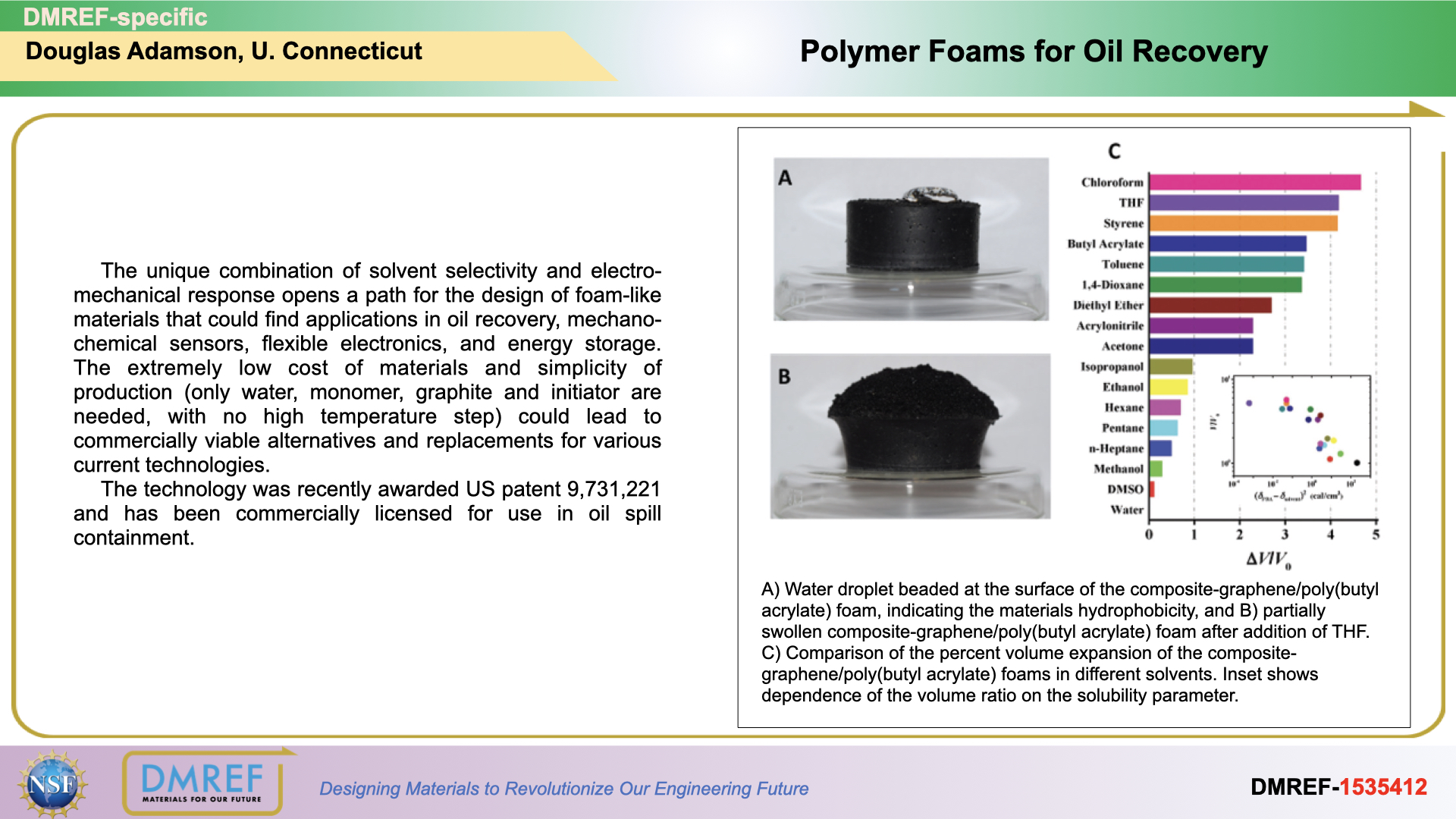
A) Water droplet beaded at the surface of the composite-graphene/poly(butyl acrylate) foam, indicating the materials hydrophobicity, and B) partially swollen composite-graphene/poly(butyl acrylate) foam after addition of THF. C) Comparison of the percent volume expansion of the composite-
graphene/poly(butyl acrylate) foams in different solvents. Inset shows dependence of the volume ratio on the solubility parameter.
A) Water droplet beaded at the surface of the composite-graphene/poly(butyl acrylate) foam, indicating the materials hydrophobicity, and B) partially swollen composite-graphene/poly(butyl acrylate) foam after addition of THF. C) Comparison of the percent volume expansion of the composite- graphene/poly(butyl acrylate) foams in different solvents. Inset shows dependence of the volume ratio on the solubility parameter.
This unique combination of solvent selectivity and electro-mechanical response opens a path for the design of foam-like materials that could find applications in oil recovery, mechano-chemical sensors, flexible electronics, and energy storage. The extremely low cost of materials and simplicity of production (only water, monomer, graphite and initiator are needed, with no high temperature step) could lead to commercially viable alternatives and replacements for various current technologies.

The technology was recently awarded US patent 9,731,221 and has been commercially licensed for use in oil spill containment. 
Authors

Douglas Adamson

Additional Materials

U.S. National Science Foundation and NSF DMREF, Materials for Our Future

This material is based upon work supported by the U.S. National Science Foundation Award No. 2015237. Any opinions, findings, and conclusions or recommendations expressed in this material are those of the author(s) and do not necessarily reflect the views of the U.S. National Science Foundation. This site is maintained collaboratively by principal investigators with NSF DMREF awards, independent of the NSF.