Recovery of Crude Oil from Aqueous Environments
Feb 18, 2020
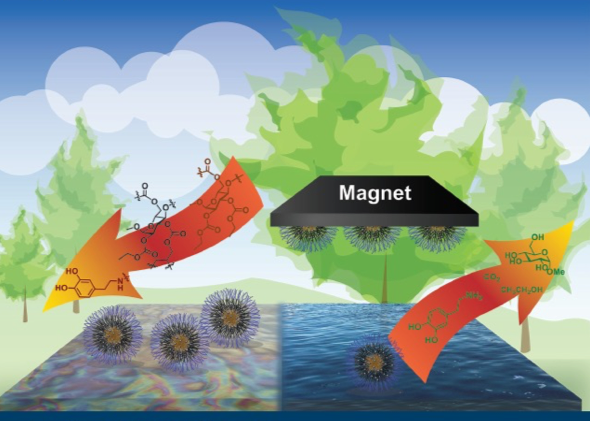
A nanoscopic sugar-based magnetic hybrid material was designed that is capable of tackling environmental pollution posed by marine oil spills while minimizing potential secondary problems that may occur from microplastic contamination.
These magnetic nanocomposites were constructed through co-assembly of magnetic iron oxide nanoparticles and a degradable amphiphilic polymer. The magnetic hybrid nanoparticles demonstrated high oil sorption capacities, about 8 times their initial dry weight, attributed, in part, to large surface areas leading to effective contact between the nanomaterials and hydrocarbon pollutants. Moreover, the naturally-derived polymer framework undergoes hydrolytic degradation to break down into byproducts that include glucose, ethanol, and dopamine if not recovered after deployment, alleviating concerns of potential microplastic generation and persistence.
These magnetic nanocomposites were constructed through co-assembly of magnetic iron oxide nanoparticles and a degradable amphiphilic polymer. The magnetic hybrid nanoparticles demonstrated high oil sorption capacities, about 8 times their initial dry weight, attributed, in part, to large surface areas leading to effective contact between the nanomaterials and hydrocarbon pollutants. Moreover, the naturally-derived polymer framework undergoes hydrolytic degradation to break down into byproducts that include glucose, ethanol, and dopamine if not recovered after deployment, alleviating concerns of potential microplastic generation and persistence.