Data Mining for Parameters Affecting Polymorph Selection
Apr 1, 2018
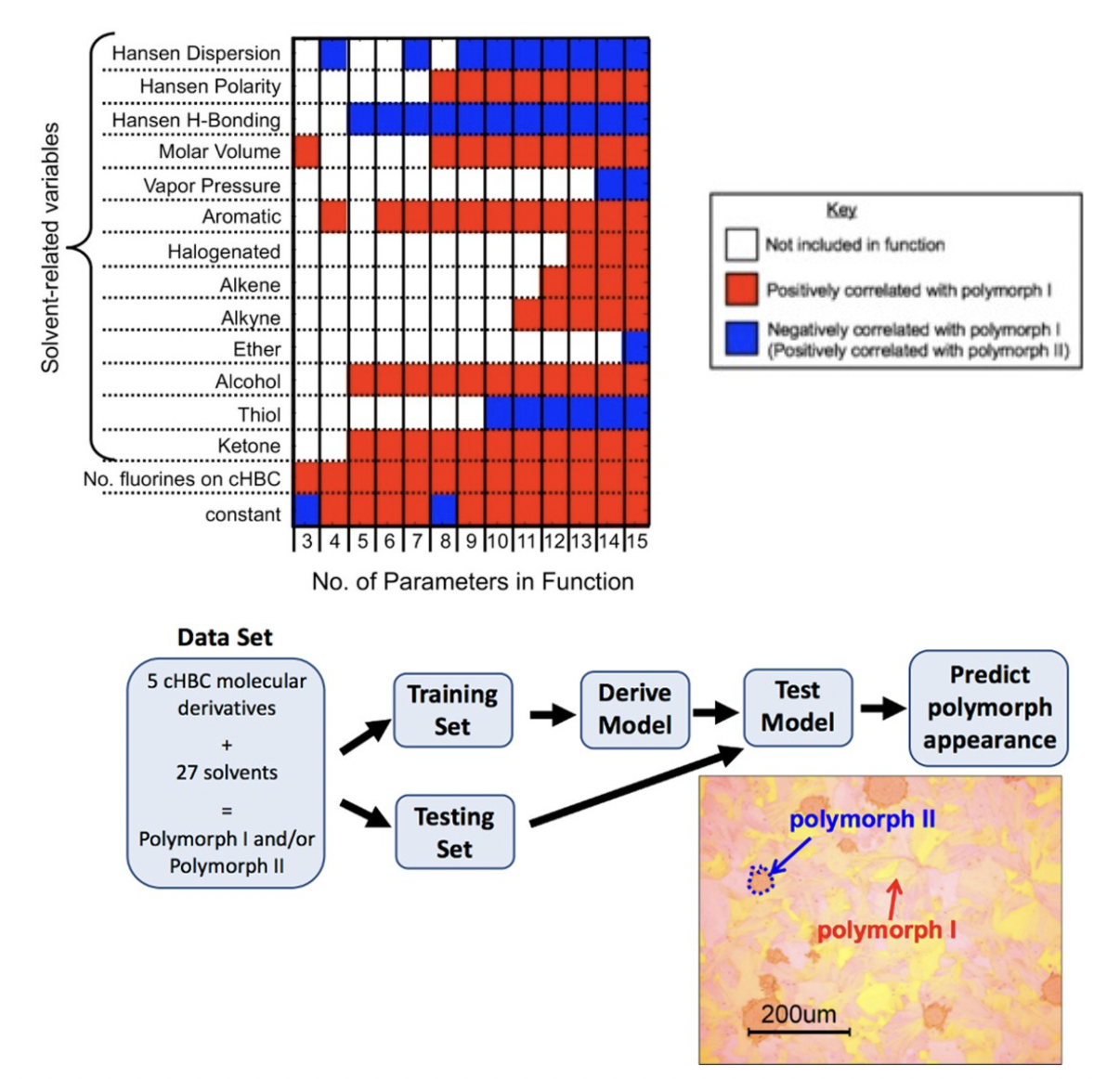
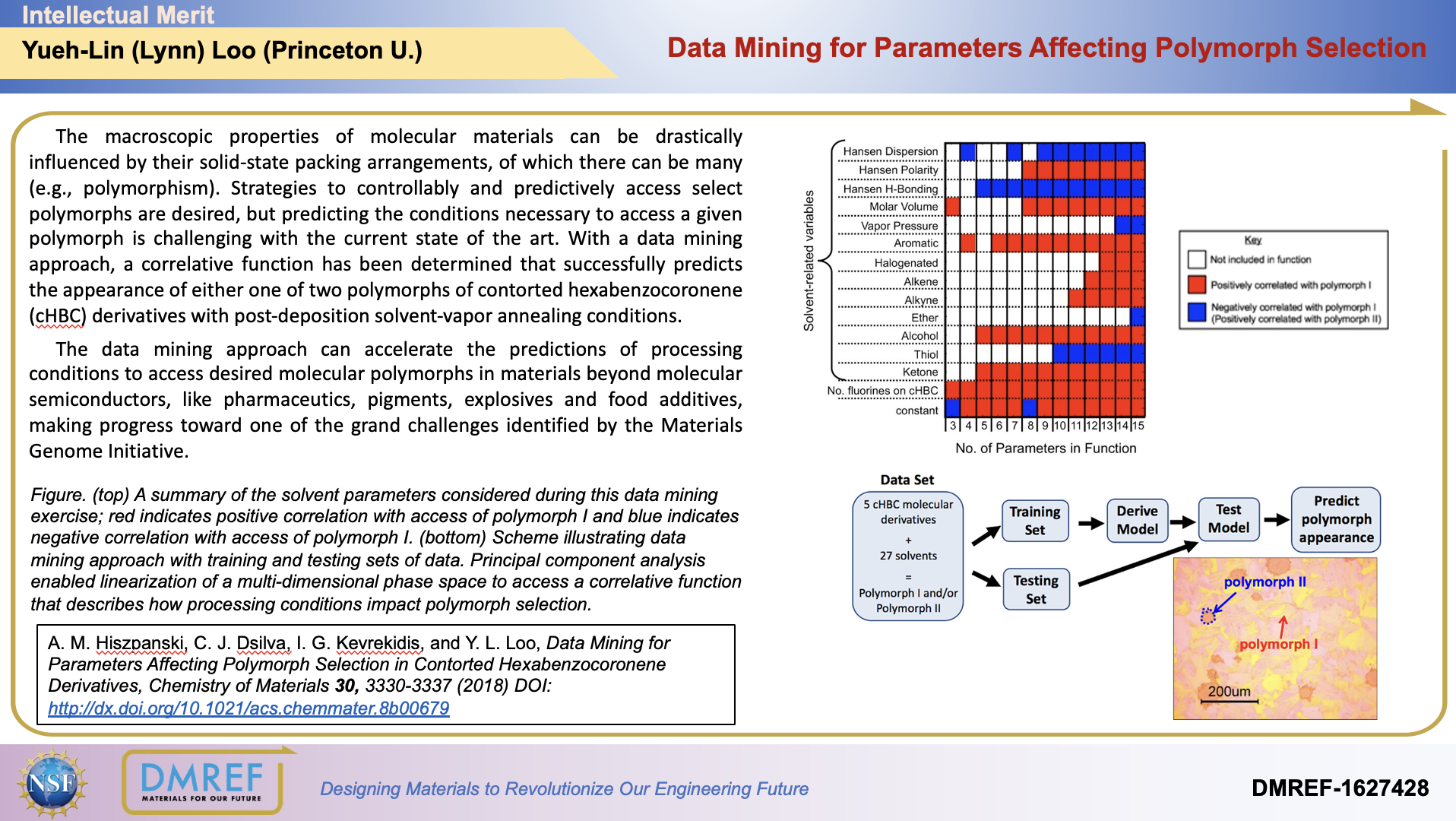
Figure. (top) A summary of the solvent parameters considered during this data mining exercise; red indicates positive correlation with access of polymorph I and blue indicates negative correlation with access of polymorph I. (bottom) Scheme illustrating data mining approach with training and testing sets of data. Principal component analysis enabled linearization of a multi-dimensional phase space to access a correlative function that describes how processing conditions impact polymorph selection.

The macroscopic properties of molecular materials can be drastically influenced by their solid-state packing arrangements, of which there can be many (e.g., polymorphism). Strategies to controllably and predictively access select polymorphs are desired, but predicting the conditions necessary to access a given polymorph is challenging with the current state of the art. 

With a data mining approach, a correlative function has been determined that successfully predicts the appearance of either one of two polymorphs of contorted hexabenzocoronene (cHBC) derivatives with post-deposition solvent-vapor annealing conditions.

The data mining approach can accelerate the predictions of processing conditions to access desired molecular polymorphs in materials beyond molecular semiconductors, like pharmaceutics, pigments, explosives and food additives, making progress toward one of the grand challenges identified by the Materials Genome Initiative.
Authors

Yueh-Lin (Lynn) Loo (Princeton U.)

Additional Materials

NSF Logo

Any opinions, findings, and conclusions or recommendations expressed on this website are those of the participants and do not necessarily reflect the views of the National Science Foundation or the participating institutions. This site is maintained collaboratively by principal investigators with Designing Materials to Revolutionize and Engineer our Future awards, independent of the NSF.

DMREF Logo