Extreme Quantum Confinement Heterostructures
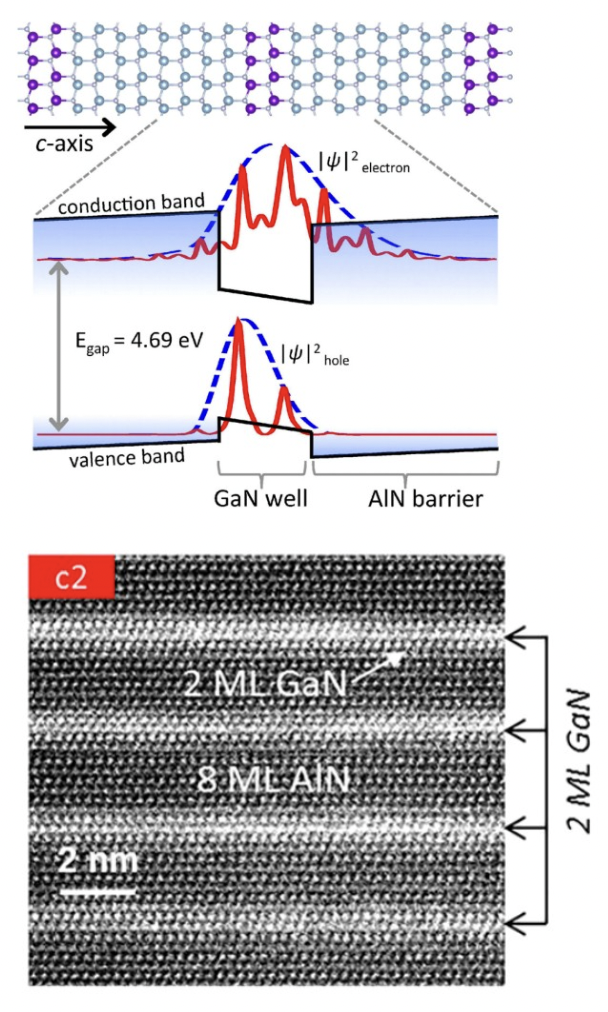
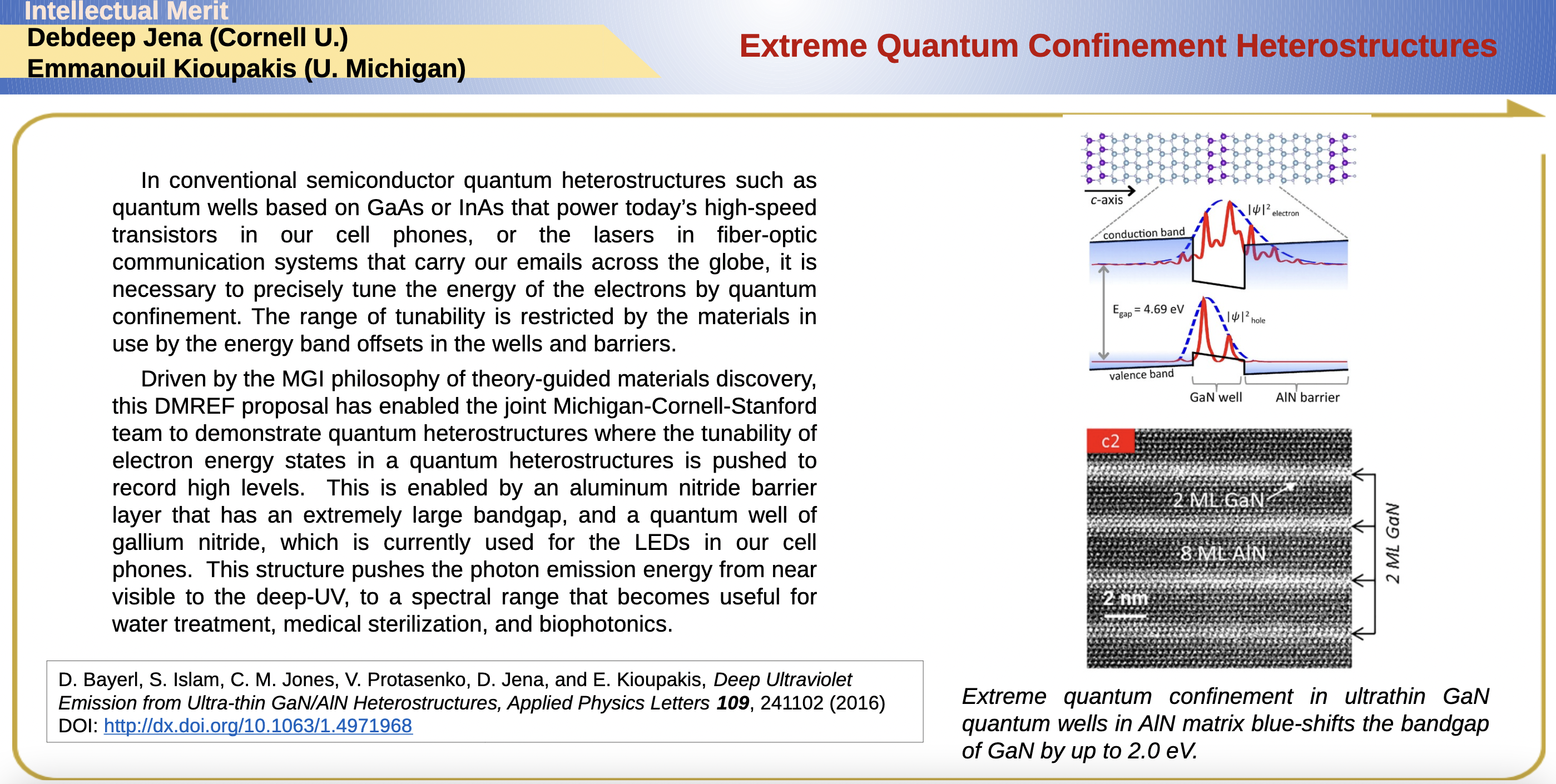
In conventional semiconductor quantum heterostructures such as quantum wells based on GaAs or InAs that power today’s high-speed transistors in our cell phones, or the lasers in fiber-optic communication systems that carry our emails across the globe, it is necessary to precisely tune the energy of the electrons by quantum confinement. The range of tunability is restricted by the materials in use by the energy band offsets in the wells and barriers.
Driven by the MGI philosophy of theory-guided materials discovery, this NSF DMREF proposal has enabled the joint Michigan-Cornell-Stanford team to demonstrate quantum heterostructures where the tunability of electron energy states in a quantum heterostructures is pushed to record high levels. This is enabled by an aluminum nitride barrier layer that has an extremely large bandgap, and a quantum well of gallium nitride, which is currently used for the LEDs in our cell phones. This structure pushes the photon emission energy from near visible to the deep-UV, to a spectral range that becomes useful for water treatment, medical sterilization, and biophotonics.