Discovery of Giant “Wine-Rack” Negative Linear Compressibility in Copper Cyanide

Jun 20, 2025
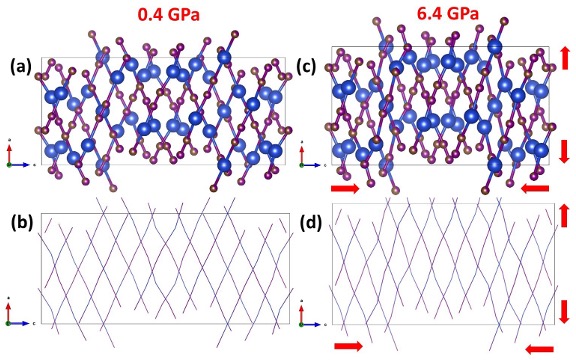
Structure of CuCN at 0.4 GPa (a) & (b) and at 6.4 GPa (c) & (d) viewed in the ac plane. Elongation along the a-axis under high pressure is observed due to the hinging of the wine-rack structure.

Copper cyanide (CuCN) has been discovered to exhibit giant negative linear compressibility (NLC), expanding along one crystalline axis under pressure - an extremely rare behavior.

Unlike other NLC materials that show either small NLC over a wide range or large NLC over a narrow range, CuCN shows large NLC over a wide pressure range, making it a unique material.

X-ray diffraction and Raman spectroscopy reveal that this unusual property arises from a remarkable "wine-rack" compression mechanism.

The discovery opens doors for advanced applications in pressure sensors, aerospace, seismic monitoring, and impact-resistant materials.
Authors

Russell Hemley (University of Illinois-Chicago)

Additional Materials

NSF Logo

Any opinions, findings, and conclusions or recommendations expressed on this website are those of the participants and do not necessarily reflect the views of the National Science Foundation or the participating institutions. This site is maintained collaboratively by principal investigators with Designing Materials to Revolutionize and Engineer our Future awards, independent of the NSF.

DMREF Logo