Evolutionary Algorithm for the Discovery and Design of Metastable Phases
Jun 20, 2025
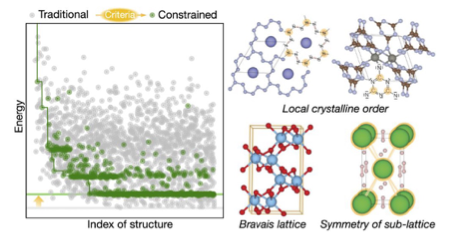
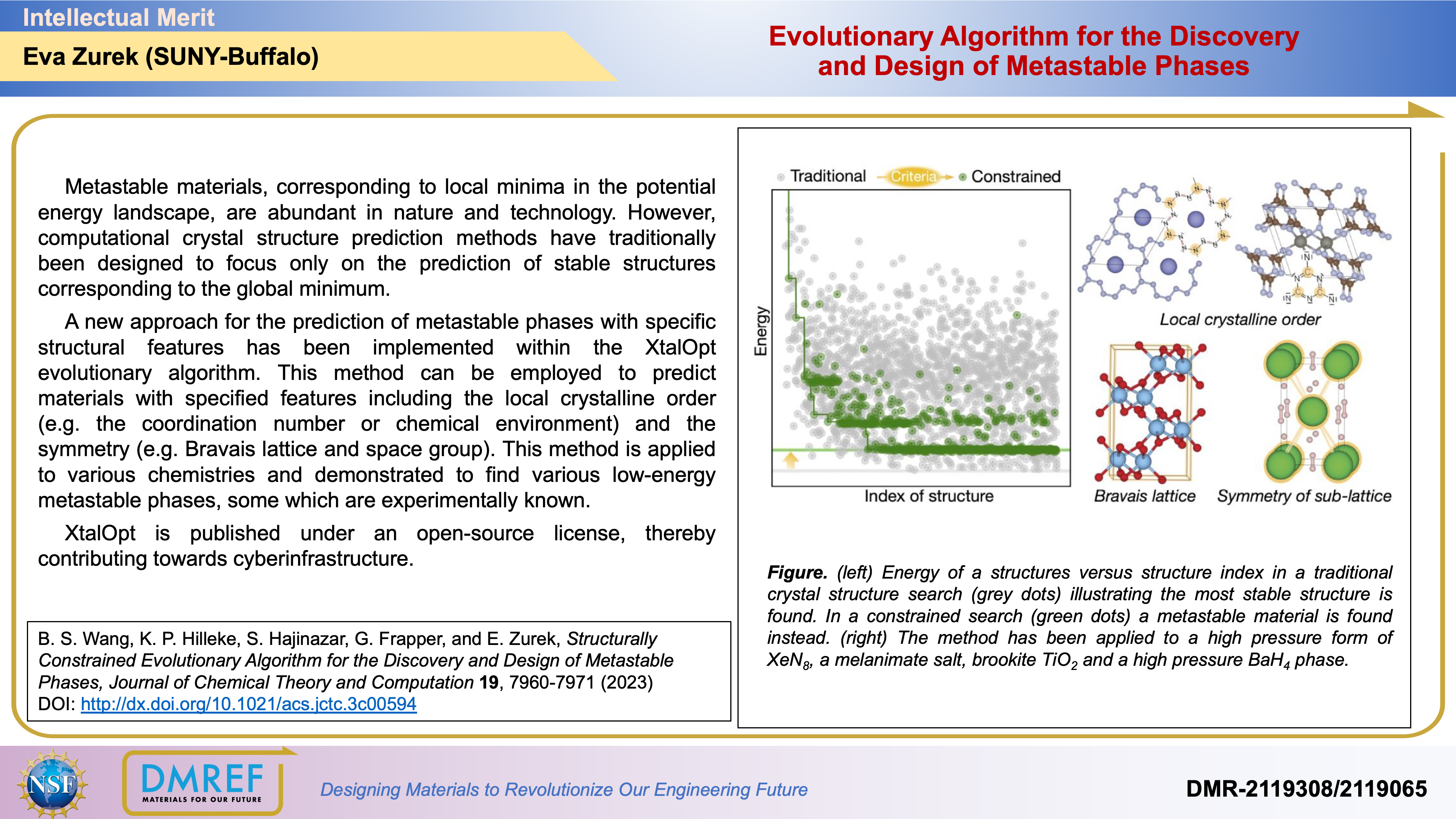
Figure. (left) Energy of a structures versus structure index in a traditional crystal structure search (grey dots) illustrating the most stable structure is found. In a constrained search (green dots) a metastable material is found instead. (right) The method has been applied to a high pressure form of XeN8, a melanimate salt, brookite TiO2 and a high pressure BaH4 phase.

Metastable materials, corresponding to local minima in the potential energy landscape, are abundant in nature and technology. However, computational crystal structure prediction methods have traditionally been designed to focus only on the prediction of stable structures corresponding to the global minimum.

A new approach for the prediction of metastable phases with specific structural features has been implemented within the XtalOpt evolutionary algorithm. This method can be employed to predict materials with specified features including the local crystalline order (e.g. the coordination number or chemical environment) and the symmetry (e.g. Bravais lattice and space group). This method is applied to various chemistries and demonstrated to find various low-energy metastable phases, some which are experimentally known.

XtalOpt is published under an open-source license, thereby contributing towards cyberinfrastructure.
NSF Logo

Any opinions, findings, and conclusions or recommendations expressed on this website are those of the participants and do not necessarily reflect the views of the National Science Foundation or the participating institutions. This site is maintained collaboratively by principal investigators with Designing Materials to Revolutionize and Engineer our Future awards, independent of the NSF.

DMREF Logo